If Your QuickBooks Environment Slowed Down This Tax Season, It Wasn’t Just a Seasonal Issue By the end of tax season, most firms already have a clear sense of how their setup performed. The signs rarely appear as complete failures, but they show up often enough to affect daily work. Reports take longer when multiple users are active, files hesitate before opening, and tasks that usually feel straightforward begin to require more time than expected.
These moments are easy to overlook in isolation because work continues and deadlines are still met. The impact becomes clear when they repeat throughout the day. Small delays accumulate, and over the course of a full season, they begin to affect how efficiently the team operates.
If your team had to slow down just to keep things stable, the issue was not temporary. It is built into the way your QuickBooks Enterprise environment is currently configured. For many firms, that becomes the point where they begin to look at how a transition could be handled without interrupting ongoing work.
What matters now is not just what happened this season, but what it signals. Setups that show strain under peak demand do not correct themselves. They repeat that behavior—often earlier and under greater pressure the next time.
Why Performance Breaks Down Under Real Demand
QuickBooks itself is rarely the issue. The infrastructure supporting it is where limitations begin to surface. Most hosting configurations are designed around average usage. They perform adequately when activity is distributed and demand remains moderate. Tax season creates a completely different condition—where activity becomes concentrated, continuous, and unforgiving.
During that time, your configuration is expected to handle:
- Multiple users accessing the same company files simultaneously
- Continuous report generation across sessions
- Large data operations without interruption
- Overlapping workflows with no buffer between tasks
This is where multi-user QuickBooks slowdown begins to appear. QBES isn’t the problem. The environment it runs in is. Systems do not fail suddenly. They reveal their limitations gradually—until those limitations become part of how your team works. By the time it becomes obvious, most teams have already adjusted how they work around it.
Why Firms Delay Switching Even When the Problem Is Clear
Most firms are not unsure about whether their setup needs improvement. The hesitation comes from the perceived risk of change. Switching hosting providers or planning a QuickBooks hosting provider migration raises practical concerns—downtime, data access, disruption to ongoing work. In accounting, even a short interruption can have real consequences, which makes caution reasonable.
At the same time, staying with the current setup often feels safer simply because it is familiar. In reality, it means continuing with a limitation that has already been observed—and will repeat with certainty. Across the industry, many firms only revisit this decision after experiencing the same slowdown pattern in consecutive tax seasons.
What a No-Downtime Migration Actually Looks Like
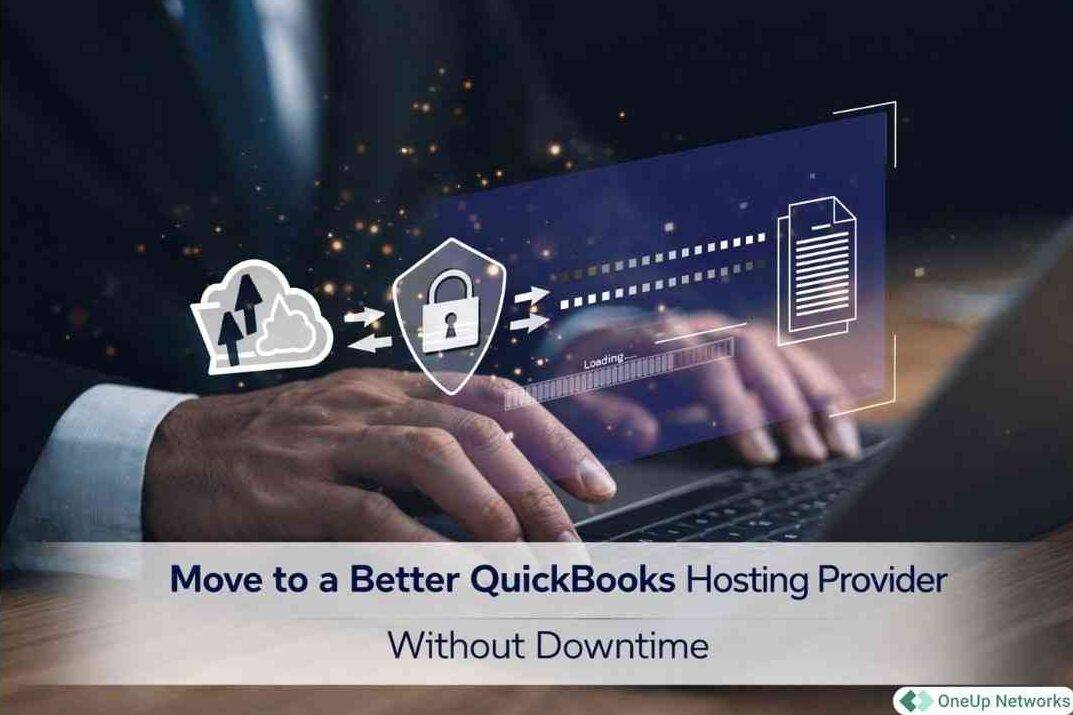
A properly structured QuickBooks migration process does not replace your system in real time. It separates preparation from transition by introducing a parallel environment.
Whether you are moving to a cloud-based setup or improving an existing hosted environment, the process follows a structured path:
- A new hosting environment is created alongside your existing configuration
- Your QuickBooks Ent data is replicated and verified before use
- User roles, permissions, and integrations are configured in advance
- Real workflows are tested under full multi-user conditions
- The final transition occurs only after validation is complete
This is what makes a QuickBooks Enterprise hosting migration without downtime possible. The system is already proven before your team depends on it.
By the time your team logs into the new environment, it is not unfamiliar. It has already been tested under the same conditions your firm operates in during peak demand. If you are unsure whether your current setup would hold under full multi-user activity, a structured performance review usually makes that gap clear. This is often where firms move from assumption to certainty.
Not sure if your current setup can handle another tax season?
Before vs After: What Actually Changes
The difference between staying and switching is not in features. It is in how consistently the environment performs under pressure.
| Scenario | Before Migration | After Structured Migration |
|---|---|---|
| Report Generation | Slows during peak hours | Remains consistent under load |
| File Access | Delays with multiple users | Immediate and stable |
| Multi-User Activity | Performance drops under concurrency | Stable across simultaneous users |
| Workflow | Adjusted to avoid lag | Runs without workarounds |
| Daily Operations | Dependent on system behavior | Predictable and consistent |
At this point, most firms can place themselves somewhere in that comparison based on how their system behaved during peak weeks. Once that becomes clear, the question is no longer whether improvement is possible. It becomes whether the current experience is acceptable going forward.
Where Most Providers Fall Short
Not every hosting provider approaches migration with the same level of preparation. In many cases, migrations are handled as technical tasks rather than operational transitions. Environments are created but not tested under real demand. Data is transferred without staged verification. User configurations are completed late, and systems go live before they are fully validated. This is where downtime originates—not from switching itself, but from switching before the environment is ready.
How OneUp Networks Handles Migration Differently
At OneUp Networks, the best alternative to RightWorks, where migration is designed to remove uncertainty before any transition takes place. The OneUp infra is built based on how your firm actually operates—user concurrency, workflow intensity, and application usage patterns. Capacity is aligned with peak demand, not averages.
The process is built around validation:
- Capacity planning based on real multi-user activity
- Staged environment preparation with verification
- Pre-configured user environments with permissions and integrations
- Real workflow testing under peak-like conditions
What separates OneUp Networks is not just how the environment is built, but how it is proven under pressure before you ever log in. Most providers confirm that a setup works. OneUp ensures it continues to perform when your entire team is active.
OneUp Networks vs Typical Hosting Providers
| Capability | Typical Providers | OneUp Networks |
|---|---|---|
| Environment Planning | Based on estimates | Based on actual firm workload |
| Multi-User Testing | Limited or simulated | Real concurrent workload validation |
| Data Migration | One-time transfer | Staged replication with verification |
| Performance Alignment | Average usage focus | Peak demand alignment |
| Migration Execution | Direct switch | Parallel environment approach |
| Downtime Risk | Possible and unpredictable | Controlled and minimized |
What the First Day After Migration Actually Feels Like
In a properly handled migration, the first day does not feel like a system change. Your team logs in, opens the same files, and continues working within the same workflows.
The difference appears in how the environment responds. Files open without hesitation. Reports generate consistently. Multi-user activity no longer slows things down. There is no adjustment period because nothing about your workflow has changed. What changes is the reliability of the system supporting it.
If Nothing Changes, What Happens Next
If your current setup remains the same, the outcome is not uncertain. The same workload conditions will return—and the same limitations will appear again. This is why many firms eventually decide to switch QuickBooks hosting provider after repeated cycles.
Frequently Asked Questions
Yes. A properly planned QuickBooks hosting migration without downtime uses a parallel environment that is tested before the final switch.
Because most hosting setups are not built for sustained multi-user activity.
If performance drops during busy periods or your team adjusts workflows to avoid lag, your setup is already under strain.
A staged migration with proper validation ensures a smooth transition without disruption.
Because that’s when system limitations become most visible and easier to fix without pressure.
Conclusion: The Decision Is No Longer About Whether It Can Be Done
At this stage, the question is not whether migration can be completed without downtime. A structured process makes that possible. The real decision is whether to continue working within a setup that has already shown its limits—or move into one that has been prepared to handle those limits in advance.
Most firms revisit this only after another tax season highlights the same issues again. By then, the cost of waiting is already visible. The real risk is not switching. It is going into another tax season with the same system.
Take the Next Step With Clarity, Not Assumption
Most firms don’t start by switching. They start by understanding whether their current configuration can realistically support another peak cycle.
You can do that with OneUp Networks through a structured review:
- Identify where performance begins to decline
- Understand whether your setup can handle peak demand
- See what a QuickBooks hosting migration without downtime would look like
Start with a simple step:
- Request a free hosting performance review
- Get a quick QuickBooks environment audit
- Book a 15-minute consultation
You don’t need to decide today. But you do need to know where your system stands before the next cycle begins. By then, the decision is no longer optional—it’s necessary.
You May Also Like These Articles:
- Is Growing Shortage of Accountants In The USA Real? Find the Reasons Here!
- The Complete QuickBooks Tax Season Optimization Guide for CPA Firms
- Why Choosing the Right Server for Your Accounting Firm Matters
- UltraTax Virtual Office CS Downtime Fixes: Key Strategies for Tax Professionals
- Top 5 Reasons Tax Professionals are Switching to Cloud Hosting