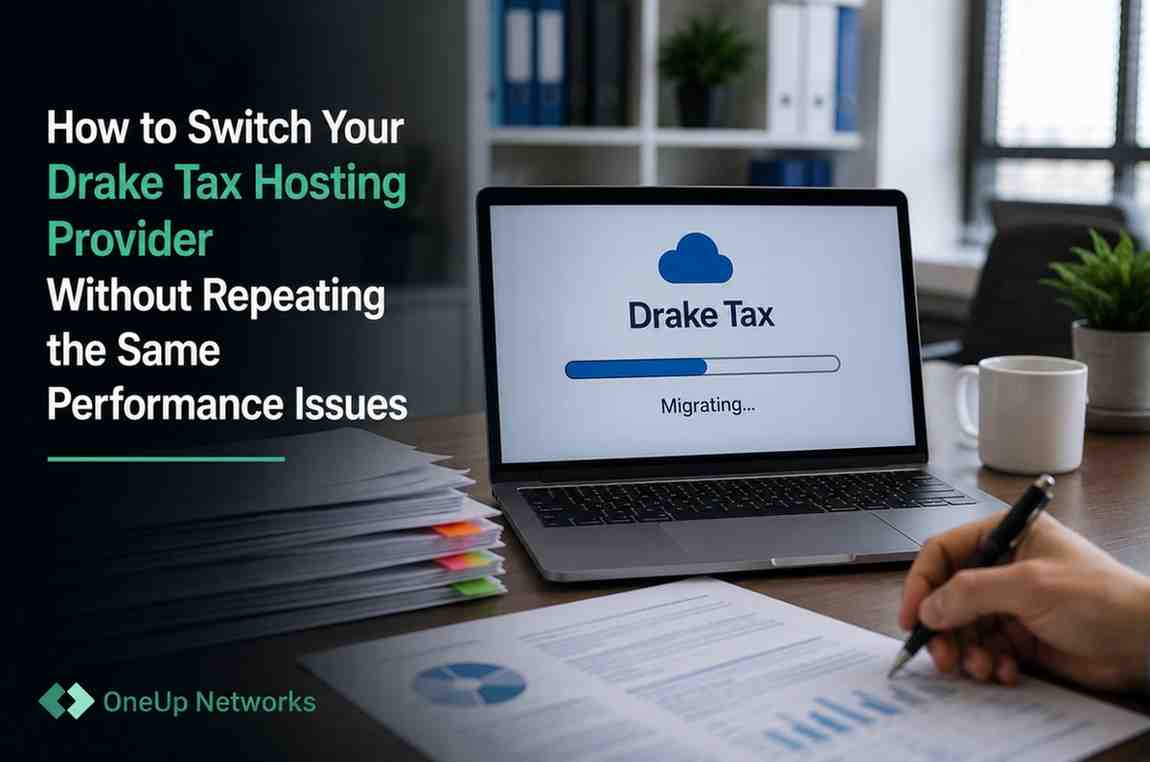
A few hours into tax season, one preparer opens Drake, another is waiting on a report, and a third user can still work, but not cleanly. The screens load, then hesitate. A return opens, but the next report stalls. One user says it is fine, another says it is slow, and the admin is left trying to decide whether it is the workstation, the network, or Drake itself—or whether it is finally time to switch Drake hosting provider before the same slowdown patterns repeat again.
The system isn’t failing—but it’s no longer predictable.
That is usually where the conversation about Drake Tax Software Hosting starts in real firms. Not with a crash. Not with an outage. It starts with inconsistency under load, and that inconsistency is what makes teams lose time, lose confidence, and eventually start looking for a better Drake Cloud Hosting setup.
What Firms Notice First?
The first signs rarely look serious. A login takes longer than usual. A tax return opens quickly for one user and slowly for another. A report that ran in seconds last week now pauses without warning. People begin to adjust their work around the software instead of relying on it.
Most systems don’t fail outright—they become unreliable in ways that are easy to overlook.
What feels inconsistent is usually predictable under load.
That is why firms miss the pattern at first. They assume the issue is temporary because the software still opens and work still gets done. But in a multi-user tax office, “still working” is not the same as “working well.”
How the Problem Develops?
Once the team is active at the same time, the system behavior changes. A single user may not notice much, but full-team concurrency exposes the weak points fast. Drake tax slow with multiple users is usually not a mystery to the people who have lived through it. It shows up as resource contention, uneven response times, and session instability that comes and goes just enough to confuse everyone.
One person gets a smooth session. Another gets delays. A third user sees a report lag after it has already loaded for everyone else. That uneven experience creates internal noise. Staff start comparing notes, and because the symptoms are not identical, the firm often misdiagnoses the problem.
They blame the internet. Then the workstation. Then a recent update. Then the user. In reality, the environment is under strain, and the strain is showing up differently across sessions.
Why it Feels Random?
Drake hosting performance issues are often described as random because they do not hit every user the same way, every time. But in real firms, the pattern is usually tied to workload density, shared resources, and how the environment handles simultaneous demand.
A workstation may appear fine until several users launch heavy tasks at once. A report may feel normal during the morning and sluggish after mid-day when the office reaches peak activity. A session may stay stable for an hour, then begin dropping or pausing when too many actions stack on top of one another.
This is where many firms waste time. They keep troubleshooting symptoms instead of addressing the environment that creates them.
Where Performance Starts Breaking Down-
In most firms, performance issues do not appear all at once. They surface gradually, tied to how the system behaves as more users rely on it at the same time. What looks like isolated delay is often the early stage of a larger pattern.
- Login delays are usually the first visible signal that the environment is under pressure during concurrent access.
- Report slowdowns tend to appear when multiple users begin interacting with shared data and processing tasks at the same time.
- Session instability often emerges later in the day, when activity peaks and the system is already carrying sustained load.
- Uneven performance across users is a sign that the environment is not distributing resources consistently under demand.
Individually, these issues are easy to dismiss. Together, they form a pattern that reflects how the hosting environment responds to real workload conditions—not just isolated usage.
Drake Tax Hosting Performance: What Firms Experience vs What’s Actually Happening
| What Firms Experience | What’s Actually Happening |
|---|---|
| One user says Drake is fast, another says it is slow. | The environment is behaving unevenly under shared workload pressure. |
| Reports pause only during busy hours. | Resource contention increases as more users compete for the same infrastructure. |
| Logins feel normal early in the day, then become inconsistent later. | Peak-hour concurrency is exposing infrastructure limitations. |
| Staff keep wondering whether the issue is local. | The slowdown is systemic, but symptoms appear differently across sessions. |
| Restarting a workstation helps temporarily. | The symptom resets briefly, but the underlying workload issue remains unresolved. |
That gap between perception and reality is where most firms lose time. They treat it as a user issue because the symptoms are scattered. In truth, the pattern is being driven by the hosting environment.
A Real Firm Pattern
A mid-sized CPA firm running Drake Tax, QuickBooks, and related tools noticed that two preparers were consistently slower than the rest of the team. At first, management assumed those users had older PCs or unstable connections. The IT vendor replaced a workstation, checked the internet line, and reset a few settings. The problem improved for a day, then returned.
What the firm experienced was uneven access and delayed reports during peak preparation hours. What they assumed was a local hardware issue. What was actually happening was that the hosted environment was not holding up cleanly under full-team concurrency. The setup looked acceptable in light use, but it broke down when the office reached real production load.
Once the firm moved to a correctly designed environment, the difference was not dramatic in a flashy way. It was practical. Logins became stable. Reports opened predictably. Users stopped comparing one another’s performance because the sessions behaved consistently.
Why Switching Alone Is Not Enough
This is the part many firms overlook when they decide to switch drake hosting provider. Changing vendors by itself does not guarantee a better result. If the next environment is built the same way, the same problems return.
If the conditions remain the same, the outcome will repeat.
That is why a proper migration is not just a move. It is a design decision. The question is not only whether you migrate drake hosting. The real question is whether the new environment is built for full-team concurrency, validated under real workload, and tuned for consistency instead of just basic access.
A correct switch changes more than the server location. It changes how the system handles demand, how sessions behave under pressure, and how the office experiences the workday.
Before and After
| Scenario | Current Setup | Correct Environment |
|---|---|---|
| Login | Delays | Stable |
| Reports | Inconsistent | Predictable |
| Multi-user | Slows | Handles load |
| User experience | Uneven | Consistent |
| Daily workflow | Interrupted | Reliable |
What Switching Your Drake Hosting Provider Actually Involves
By the time a firm reaches the point of considering a switch, the issue is usually no longer unclear—it is repeated. The same slowdowns, the same inconsistencies, and the same workarounds continue to appear under similar workload conditions.
Switching a Drake tax hosting provider is not a single action. It is a sequence of decisions that determine whether the outcome will actually improve.
Firms that approach it correctly focus on a few key areas:
- Environment design — whether the new setup is built for full-team concurrency, not just access
- Workload alignment — whether the infrastructure matches how the firm actually operates during peak periods
- Performance validation — whether the system has been tested under real multi-user load, not just idle conditions
- Migration planning — how data, user access, and workflows will transition without disruption
- Post-migration stability — whether the environment remains consistent after the switch
The goal is not simply to move Drake to a different server. It is to ensure that the next environment removes the conditions that caused the original problem.
What happens if nothing changes
The biggest risk is not a single outage. It is repetition. The same delays show up at the same time of year. The same users become frustrated. The same reports slow down when the team needs them most. The same internal debates start again about whether the issue is Drake, the internet, the workstation, or the user.
That cycle burns time in the wrong place. It also creates a false sense of normal. Teams start accepting inconsistent performance as part of tax season, when in reality it is a hosting decision that keeps replaying itself.
And when the office is already under deadline pressure, small inefficiencies become operational drag. The cost is not just slower screens. It is lost momentum, delayed review cycles, and avoidable strain on staff.
Why timing matters
Firms usually wait too long because the system is not dead yet. But waiting for a hard failure is the wrong trigger. By the time the environment becomes obviously broken, the team has already absorbed weeks of friction.
That is why the decision point usually arrives before the next cycle, not during it. If you already see drake hosting performance issues now, the same pattern is likely to return under heavier load later. If the office is already experiencing drake tax slow with multiple users, tax season will not make that better.
The right moment to switch is before the next surge exposes the same weaknesses again.
How OneUp Networks Helps Firms Avoid Repeat Hosting Problems
Many firms switch hosting providers expecting the experience to improve immediately, only to run into similar slowdowns again a few months later. Reports still lag during busy hours, sessions become uneven under load, and users start adjusting their work around the system instead of trusting it. In many cases, the problem is not the migration itself—it is that the new environment was never designed differently from the old one.
OneUp Networks helps firms move away from that cycle by focusing on how accounting environments behave during real tax-season workload. Instead of treating hosting as simple remote access, the environment is designed around stable multi-user performance, predictable session behavior, and smoother report handling during peak activity. The goal is not just to move Drake to another server. It is to help firms avoid repeating the same operational problems that pushed them to switch in the first place.
How to Reduce Tax-Season Slowdowns With OneUp Networks
Tax-season pressure exposes weaknesses that often stay hidden during lighter usage. A setup that feels acceptable with a few active users can become inconsistent once the full office starts processing returns, generating reports, and working across multiple applications at the same time. That is when delays begin spreading across the workflow and productivity starts slowing down.
OneUp Networks supports accounting environments built for those real workload conditions. The focus is not only keeping Drake accessible, but helping firms maintain stable performance during the busiest periods of the season. That includes reducing session instability, improving consistency across users, and helping the environment handle full-team concurrency more smoothly when workload demand increases.
FAQs
Login delays, slower reports, and inconsistent response times between users are usually the first signs.
That usually points to uneven behavior under shared load, not a problem isolated to one workstation.
No. The new environment has to be designed correctly, or the same issues can return.
Consistency under load, stable multi-user sessions, predictable report performance, and support for full-team concurrency.
Conclusion: When Switching Becomes the Right Decision
The pattern is usually visible long before the firm makes a move. One user slows down. Another stays fine. Reports begin to lag. Sessions become uneven. The office keeps working, but not confidently. That is the sign that the problem is no longer just about software access. It is about the environment carrying the load.
This is why switching becomes the right decision. Not because the current setup has stopped working completely, but because it has stopped behaving predictably. And in a tax firm, unpredictability is the real cost. If the conditions remain the same, the outcome will repeat. When the pattern is clear, the decision is no longer optional—it’s necessary.
Stop Repeating the Same Drake Hosting Problems Every Tax Season
Many firms continue using the same hosting setup because the system technically still works. But recurring delays, unstable remote sessions, and inconsistent responsiveness are usually signs that the environment is no longer built for your real workload.
OneUp Networks helps firms run Drake Tax Software in hosting environments designed for steadier multi-user performance, smoother remote access, and more reliable responsiveness during filing season.
- Free Hosting Performance Review – Identify what’s causing instability and slowdown in your Drake environment
- 15-minute Consult – See how smoothly your current Drake setup can transition into a more stable environment
- Book a Demo – Experience a hosting setup built to stay stable during peak accounting workload and filing-season pressure
You May Also Like These Articles:
- 7 Signs Your Current QuickBooks Hosting Provider Is Costing Your Firm More Than You Think
- Why Drake Tax Runs Better on Citrix: The Best Hosting Option for Remote Teams
- What Are The Benefits Of Using Drake Tax Software For Small Businesses?
- What Are The Key features of Drake Tax Software That Make It Stand Out?
- Facing Issues with Drake Tax Desktop Software? Find Answers To FAQs & Cloud Hosting Solutions