Tax and Accounting Technology Updates are arriving faster than most CPA firms can keep up with.
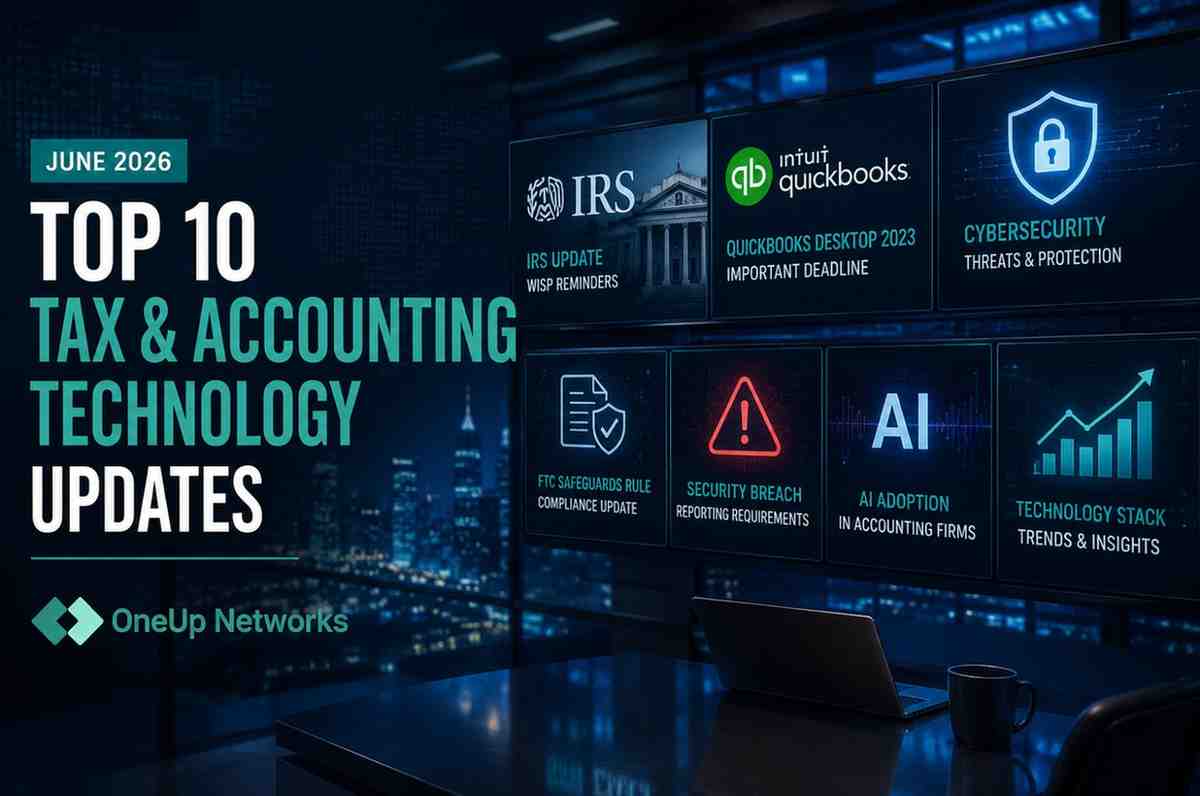
In just the past few weeks, one major QuickBooks deadline has passed, cybersecurity expectations have continued to rise, regulators have renewed their focus on data protection, and artificial intelligence has become an even bigger part of day-to-day accounting workflows. While each update may seem small on its own, together they reveal a bigger story about where the profession is heading.
The challenge isn’t finding information anymore. CPA firms are overwhelmed with software announcements, compliance guidance, IRS alerts, security warnings, and industry reports. The real challenge is identifying which developments actually deserve your attention and what actions, if any, your firm should take.
That’s why we’re launching the OneUp Networks Monthly CPA Technology Briefing—a recurring roundup of the most important tax, accounting, cybersecurity, cloud, and technology developments affecting accounting firms. On the first of every month, we’ll cut through the noise and highlight the updates that matter most.
For July 2026, we’ve reviewed announcements and guidance from the IRS, FTC, Intuit, AICPA, and other trusted industry sources to identify ten developments that could influence your firm’s technology strategy, compliance posture, software decisions, and operational planning in the months ahead.
July 2026 Accounting Technology Updates at a Glance
The accounting profession continues to evolve rapidly as technology, cybersecurity, compliance requirements, and software platforms undergo constant change. This month, several developments stand out for CPA firms, including ongoing IRS security guidance, major QuickBooks Desktop support changes, increased attention on cybersecurity preparedness, and growing adoption of artificial intelligence across accounting workflows. The updates below highlight the most important developments from July 2026 and explain why they deserve your attention as you plan for the months ahead.
1. The IRS Keeps Bringing Up WISP — And There’s A Reason For That
One thing the IRS has been unusually consistent about is reminding tax professionals to maintain a Written Information Security Plan, better known as a WISP.
Many firms assume having antivirus software and secure passwords is enough. The IRS disagrees. A WISP is supposed to document how your firm protects taxpayer data, who is responsible for security decisions, how employee access is managed, and what steps should be taken if client information is compromised. The agency even provides Publication 5708 specifically to help firms build one.
What stands out is that the IRS continues repeating this message year after year. That usually signals regulators are seeing firms fall behind in this area.
Key Points
- WISP is required for tax professionals handling taxpayer information.
- The IRS provides Publication 5708 as a planning resource.
- Security planning must be documented, not just implemented.
Source: IRS Publication 5708, IRS Security Summit
2. QuickBooks Desktop 2023 Has Reached Its Biggest Deadline Yet
For firms still using QuickBooks Desktop 2023, May 31, 2026 was not just another software date on the calendar.
After that deadline, connected services tied to the software stop working. That includes payroll services, online banking connections, payment processing features, and certain support functions. The software itself may still open, but many of the tools firms rely on daily are no longer supported.
A surprising number of firms delayed planning for this transition because QuickBooks Desktop still feels familiar and stable. Now many are being forced to make decisions about upgrades, hosting environments, or alternative accounting systems.
Key Points
- Payroll and banking integrations lose support.
- Security updates stop after discontinuation.
- Firms still using 2023 versions should review upgrade plans immediately.
Source: Intuit
3. Cybersecurity Questions Are Starting To Affect New Business
A few years ago, most clients only cared about pricing, responsiveness, and accounting expertise.
Now firms are increasingly being asked questions about data protection before engagements are signed. Prospective clients want to know where files are stored, whether encryption is used, and how firms respond to security incidents. Larger businesses especially are becoming more cautious about who handles their financial information.
What used to be an internal IT conversation is slowly becoming part of the sales process.
Key Points
- Security practices influence client trust.
- Data protection questions are becoming common during onboarding.
- Firms with documented security procedures have an advantage.
Source: IRS Guidance, FTC Guidance
4. The FTC Is Still Pressuring Firms To Take Security Seriously
The FTC Safeguards Rule continues to be one of the most important regulations affecting businesses that handle sensitive financial information.
Under the rule, covered organizations must maintain a written information security program that includes administrative, technical, and physical safeguards. The goal is simple: customer information should not be exposed because of weak controls or poor security planning.
A lot of accounting firms know the rule exists. Far fewer have actually reviewed whether their current processes satisfy all of its requirements.
Key Points
- Written security programs are expected.
- Risk assessments remain important.
- Vendor security oversight is part of compliance.
Source: FTC
5. Security Breach Reporting Requirements Are Getting More Attention
One update that many smaller firms still don’t know about involves security breach reporting.
The FTC now requires certain covered organizations to report security incidents affecting 500 or more individuals. Those reports can become public, which adds another layer of reputational risk for firms handling sensitive customer information.
This is one reason cybersecurity discussions have become much more serious inside accounting firms over the last year.
Key Points
- Large security incidents may require FTC reporting.
- Public disclosure can increase reputational damage.
- Incident response planning is becoming essential.
Source: FTC Safeguards Rule Reporting Requirements
6. AI Is Quietly Becoming Part Of Everyday Accounting Work
Publicly, many firms still say they’re “exploring AI.”
Privately, a lot of staff members are already using it.
Some use AI tools to summarize lengthy IRS notices. Others draft client emails, organize research notes, or rewrite technical explanations into simpler language. The bigger concern now isn’t whether firms are using AI — it’s whether leadership has created policies governing how those tools should be used.
That’s the conversation many industry groups are focusing on in 2026.
Key Points
- AI adoption is increasing across accounting workflows.
- Firms need internal governance policies.
- Client confidentiality remains a major concern.
Source: AICPA, Journal of Accountancy
7. The IRS Security Summit Is Still Warning About Phishing Attacks
Every year, cybercriminals continue targeting tax professionals because accounting firms store enormous amounts of personal and financial information.
The IRS Security Summit has repeatedly warned firms about phishing emails, credential theft, ransomware attacks, and social engineering scams. Attackers know that one compromised employee account can potentially expose hundreds or thousands of taxpayer records.
The threat isn’t new, but it isn’t slowing down either.
Key Points
- Phishing remains one of the biggest attack methods.
- Multi-factor authentication is strongly recommended.
- Employee security awareness training remains critical.
Source: IRS Security Summit
8. Annual Security Assessments Are Becoming Normal Business Practice
A noticeable shift happening across the profession is how firms think about cybersecurity reviews.
Several years ago, security assessments were often performed only after an incident occurred. Today many firms schedule annual reviews to identify vulnerabilities before they become major problems. These assessments often cover backups, user permissions, software updates, vendor risks, and remote access controls.
Security reviews are gradually becoming as routine as financial audits.
Key Points
- Annual assessments help identify hidden risks.
- Preventive reviews are cheaper than breach recovery.
- Security monitoring is becoming part of standard operations.
Source: AICPA, Industry Security Guidance
9. More Firms Are Re-Evaluating Their Technology Stack
Between software price increases, cloud migration pressure, AI adoption, and security requirements, many firms are taking a fresh look at their technology environment.
Some are moving deeper into cloud platforms. Others are choosing hosted desktop environments that allow them to keep familiar applications while gaining remote access and stronger infrastructure management. There is no universal approach, which is why technology planning discussions have become much more strategic.
The firms making these decisions now will likely avoid expensive rushed migrations later.
Key Points
- Technology planning is becoming a leadership discussion.
- Cloud adoption continues growing.
- Firms are prioritizing flexibility and security.
Source: Accounting Technology Industry Reports
10. Security Is Becoming A Competitive Advantage — Not Just A Compliance Requirement
Perhaps the biggest shift happening right now is how firms view cybersecurity.
For years, security was treated as something firms invested in simply because regulators required it. Now many firms are realizing that strong security practices can actually strengthen client relationships and improve business credibility.
Clients want to know their financial information is protected. Firms that can confidently explain their security practices are increasingly separating themselves from competitors who still treat cybersecurity as an afterthought.
Key Points
- Clients increasingly evaluate security practices.
- Trust has become a competitive differentiator.
- Strong cybersecurity supports long-term growth.
Source: IRS, FTC, AICPA
Final Thoughts
Accounting firms are entering a period where technology decisions matter just as much as tax expertise. Whether it’s cybersecurity compliance, software upgrades, artificial intelligence, or client data protection, the firms that stay informed today will be better prepared tomorrow.
These tax and accounting updates aren’t just industry headlines—they’re signals of where the profession is heading next. If even one of these updates impacts your firm, now is the time to review your processes, strengthen your security posture, and plan ahead before the next major change arrives.