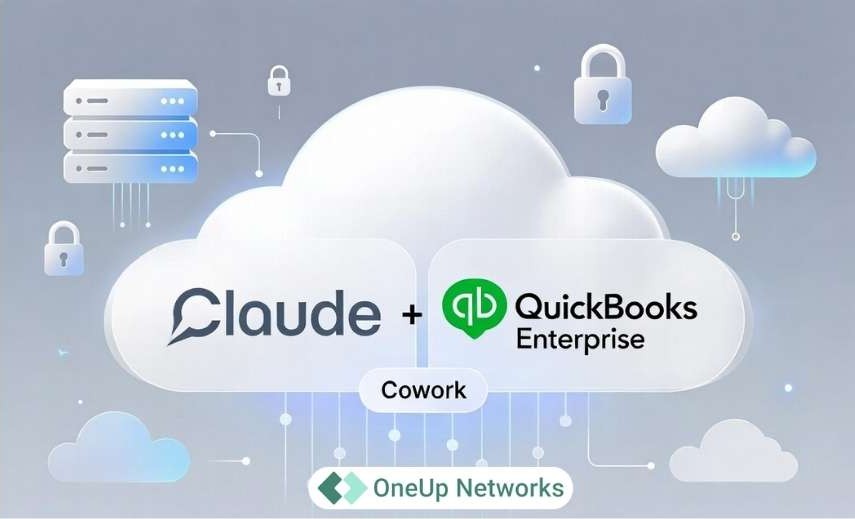
There’s a conversation happening in nearly every accounting firm, mid-sized business, & finance department right now : “We’re already on QuickBooks Enterprise — can we use Claude with it? And does it work better if we’re hosted in the cloud?“
The short answer is yes. The longer answer is what this guide is about.
Between the Intuit–Anthropic partnership announced in early 2026, the rapid rise of Claude’s Cowork tool for knowledge workers, and a growing ecosystem of MCP-based integrations, the path to AI-powered accounting on a hosted QuickBooks Enterprise environment has never been clearer — or more worth understanding properly before you make any decisions.
We’ve put this together for business owners, CFOs, CPAs, and IT decision-makers who want real, accurate information — not just hype. We’ll cover what’s actually possible today, what’s coming, where the limitations are. Focusing on what a proper cloud-hosted setup looks like when you want Claude and QuickBooks Enterprise to work together reliably.
First, Let’s Clarify What “Cloud-Hosted QuickBooks Enterprise” Actually Means
This is where a lot of confusion starts, so it’s worth getting straight before anything else.
QuickBooks Enterprise is not a cloud-native product like QuickBooks Online. It’s a desktop application — installed on a Windows machine — that Intuit has continuously expanded with more powerful features: up to 40 simultaneous users, advanced inventory management, industry-specific editions, complex job costing, detailed reporting, and role-based permissions that QuickBooks Online simply doesn’t match.
When we say “cloud-hosted QuickBooks Enterprise,” we mean the software and your company file live on a secure remote server managed by an expert hosting provider (like OneUp Networks). And your team connects to it through an encrypted Remote Desktop session. From your screen, it looks & behaves exactly like it would on an office PC — being the same software. The difference is that the hardware, backups, security patching, uptime monitoring, and multi-user performance are all handled by professionals, not your internal IT person or a dusty server in the back room.
This distinction matters enormously when we start talking about AI integration, because the path for connecting Claude to cloud-hosted QuickBooks Enterprise is different from connecting it to QuickBooks Online — and it’s important to know which path applies to you.
The Intuit–Anthropic Partnership: What It Means?
In February 2026, Intuit and Anthropic announced a multi-year partnership that put QuickBooks, TurboTax, Credit Karma, and Mailchimp directly inside Claude’s ecosystem. According to the official press release, the partnership is designed to bring trusted financial intelligence and custom AI agents to mid-market businesses — with Intuit’s financial data and tools accessible from within Cowork, Claude for Enterprise, and Claude.ai through MCP (Model Context Protocol) integrations.
What this means practically: if you’re a QuickBooks user, you can now connect your financial data to Claude and ask it to generate profit and loss statements, analyze cash flow, compare performance against industry benchmarks, or identify which expense categories are growing fastest — all in natural language, without navigating through a maze of QuickBooks report menus.
Businesses using QuickBooks within Claude can analyze key metrics like profitability, cash flow, and benchmarks, comparing their own performance against similar businesses by industry and region.
These features began rolling out to Intuit customers in spring 2026, starting with Intuit Enterprise Suite users, with broader QuickBooks integration following.
What QBES (QuickBooks Enterprise Desktop) users specifically need to know:
Here’s the honest picture, because this is the question we hear most from our hosted clients. The native Intuit–Anthropic integration is currently most mature for QuickBooks Online and Intuit Enterprise Suite — Intuit’s newer cloud-only platform. Desktop Enterprise users working in a hosted environment are not yet plugged into this natively.
That said, this doesn’t leave QBES users behind — it just means the integration path is slightly different. Businesses running QuickBooks Enterprise in a hosted cloud environment can connect Claude to their financial data through export-based workflows, third-party MCP connectors (more on this below), or by exporting reports from QuickBooks into formats Claude can analyze. The native, real-time API connection that QBO users get is something the industry expects to expand to hosted Desktop environments as the Intuit–Anthropic roadmap matures, but it hasn’t been officially confirmed for a specific timeline at the time of writing.
The practical workaround that works today: export your key QuickBooks Enterprise reports (P&L, balance sheet, AR aging, cash flow) and bring them into Claude via Cowork for deep analysis, narrative generation, scenario modeling, and client-ready summaries. It’s not plug-and-play like QBO, but it delivers substantial value — and the hosted cloud makes it accessible and secure.
What Is Claude Cowork, and Why Does It Matter?
Claude Cowork launched in January 2026 as Anthropic’s answer to the question: what does AI look like for those who don’t write code? It runs inside the Claude Desktop application on Windows/Mac, & it gives Claude direct access to your file system. Meaning it can read documents, process spreadsheets, generate formatted reports, and complete multi-step tasks autonomously. For accounting and finance teams, this is genuinely useful while you step away and get on with other work
Some examples of what Cowork can do right now:
Financial document processing: Point Cowork at a folder of bank statements, receipts, or client-provided financial files. Tell it to extract dates, vendors, amounts, and categories into a structured CSV. It does it. No manual data entry, no formulas to maintain.
Month-end report generation: Give Cowork your QuickBooks-exported P&L and comparative balance sheet data, and ask it to draft a board-ready narrative summary — the kind that explains the numbers in plain language rather than just presenting the table. Cowork generates it in the format and tone you specify.
Client advisory prep: Before a client meeting, Cowork can review a folder of documents — previous financials, meeting notes, email threads. Then it produce a briefing that surfaces the key questions you should be asking and the trends worth discussing.
Recurring workflow automation: Cowork supports scheduled tasks and saved “Skills” — essentially templates for recurring processes. Set up a weekly cash flow summary routine once – Cowork runs it automatically each time with the latest data you’ve dropped into the folder.
Cowork works best on tasks that are repeatable and well-defined. The more clearly you can describe what “done” looks like, the better the output. And unlike ChatGPT or basic Claude chat, Cowork actually creates the files, saves them, and hands them back to you — it’s not just generating text on a screen.
Integration That Works: For QuickBooks Enterprise + Claude
Depending on your setup and how much technical investment you want to make, there are three realistic paths for getting Claude working with QuickBooks Enterprise in a cloud-hosted environment.
Path 1: Export + Cowork (Works Today, No Technical Setup)
This is the simplest and most accessible route for any QBES user. Export your financial reports from QuickBooks Enterprise in Excel or CSV format, place them in a designated folder that Cowork has access to, and prompt Claude to analyze and act on them.
You can get surprisingly sophisticated with this approach. Using Windsor.ai’s MCP connector, which streams QuickBooks data into Claude and keeps it updated automatically, teams have been running analyses like cash runway projections, AR aging breakdowns, job profitability by class, and comparative period analysis — all in natural language, without touching a formula. Windsor’s connector currently works directly with QuickBooks Online data, but the export pipeline for Enterprise achieves comparable results for firms willing to run a regular export routine.
This path doesn’t require any changes to your hosting environment. It works out of the box on any cloud-hosted QBES setup.
Path 2: MCP-Based Integration via Third-Party Connectors
MCP (Model Context Protocol) is the open standard that lets Claude connect to external tools and data sources as if they were native extensions of its capabilities. A growing ecosystem of MCP servers now connects Claude to QuickBooks data — Composio, CData Connect AI, Breadwinner AI, and Windsor are among the providers building these connectors.
For hosted QuickBooks Enterprise environments, an MCP-based setup involves configuring a connector that bridges your QuickBooks company file data (typically via ODBC or API export) with Claude’s session on the same cloud desktop. This requires a modest amount of technical configuration — something OneUp Networks can set up as part of a managed integration — but once in place, it allows Claude to query your QuickBooks data more dynamically than pure export workflows allow.
What can Claude do through an MCP connector to QuickBooks data? Generate customer balance reports, query vendor details, create account summaries, analyze payment patterns, surface overdue invoices, and compare current period performance against prior periods — all triggered by a natural language prompt, with results that can be forwarded into Cowork for document creation.
Path 3: Claude for Enterprise + Hosted Cloud Environment
For larger organizations on Claude for Enterprise plans, the hosted cloud environment becomes a particularly compelling architecture. Rather than running Cowork on individual desktops, the Claude instance can be configured to connect to shared folders and data sources on the hosted server — meaning the entire team works from the same AI-accessible environment, with consistent permissions, consistent data, and centralized governance.
This is the architecture OneUp Networks specializes in designing for clients. The hosted cloud server becomes the single, secure hub where QuickBooks Enterprise runs, Cowork has authorized file access, and data flows cleanly between the accounting application and the AI layer without going through consumer-grade tools or personal machines.
Why Cloud Hosting Is Not Optional If You’re Serious About This
Let’s address something directly. Can you run Claude Cowork with QuickBooks Enterprise from a local desktop setup? Technically, yes — but it creates several real problems.
Data silos and access limitations. If QuickBooks Enterprise runs on a single office machine, your data is trapped there. Cowork, running on the same or a different machine, has limited access to that file system in a way that a centrally hosted environment doesn’t. Cloud hosting puts QuickBooks and Cowork on the same infrastructure, with coherent file access policies.
Security and compliance exposure. Running sensitive financial data through AI tools on unmanaged local machines creates compliance risk — particularly for firms governed by the FTC Safeguards Rule, which requires a formal written information security plan. A hosted cloud environment with SOC 2 Type II infrastructure, MFA, encrypted connections, and regular audits is the appropriate foundation for running AI tools against client financial data.
Performance degradation. QuickBooks Enterprise with 20+ simultaneous users on an underpowered local server is noticeably slow. Add AI processing on top of that and you’ve compounded the problem. Cloud hosting provides dedicated, scalable compute resources that maintain performance regardless of how many users are active or how many Cowork tasks are running in parallel.
Backup and recovery. Cowork, when given folder access, reads and writes files. Without a professional backup regime, there’s real risk of data loss if something goes wrong. A hosted environment with daily backups, versioning, and tested disaster recovery procedures eliminates that risk.
The bottom line: the cloud-hosted environment isn’t just a nice-to-have for AI integration. It’s the foundation that makes it work safely and reliably at a business level.
What Claude Can and Cannot Do with Your QuickBooks Data?
It’s worth being clear about this because expectations often outrun reality, and reality is still genuinely impressive.
What Claude can do today with QuickBooks Enterprise data:
- Analyze exported financial reports and identify trends, anomalies, and performance variances
- Generate narrative summaries of P&L, cash flow, and balance sheet data in plain language
- Compare multiple periods or business units side-by-side and explain the differences
- Draft client-facing financial summaries, board presentations, and executive reports
- Build AR aging analyses and flag high-risk accounts
- Run cash flow runway projections based on current burn and bank balances
- Automate recurring report compilation from folder-based exports
- Prepare meeting briefings that connect financial data with context from emails, notes, and documents
What Claude cannot do (important limitations):
Claude does not write back to QuickBooks. All current integrations — including the native Intuit–Anthropic features — are read-oriented. Claude reads, analyzes, and summarizes your data, but it does not record transactions, modify company file, or post journal entries. All changes to your QuickBooks data still happen inside QuickBooks itself, by you or your team.
Claude is also not a CPA, and its financial analysis should be reviewed by a qualified professional before acting upon or shared with clients. It’s an analytical assistant, not an autonomous financial advisor.
Security: The Question Every Finance Professional Should Ask
Before connecting any AI tool to financial data, the right question is:
- Where does my data go?
- Who can see it?
Here’s how the major integration approaches handle this:
When you use Cowork with exported files in a hosted environment, your data stays within your hosted server. Claude processes the content in its session, but the source files remain on your infrastructure. Anthropic’s data handling for Claude follows their published privacy and enterprise data policies — Enterprise plan customers have zero data retention options.
MCP connectors like Composio are SOC 2 Type 2 compliant, with all sensitive data — tokens, API keys, credentials — encrypted at rest and in transit.
The Intuit-native integration operates within Intuit’s own security and compliance infrastructure, drawing on Intuit’s years of investment in AI security, privacy, and compliance — the same infrastructure that protects millions of QuickBooks users today.
For firms in regulated environments (healthcare, legal, financial advisory), the enterprise hosting configuration — where data access is segmented by role, audit-logged, and governed by formal policy — is the appropriate setup. This is what a quality cloud hosting provider designs for you as part of the onboarding process.
What This Looks Like in Practice: A Day in the Life!
Here’s a realistic picture of what using Claude and Cowork within a cloud-hosted QuickBooks Enterprise environment looks like for a mid-sized accounting firm.
In the morning, a staff accountant logs into the hosted cloud server from home — one click, secure remote desktop, same QuickBooks they use every day. They run their standard month-end reports and drop the exports into a shared Cowork folder. A scheduled Cowork task — set up once by the firm administrator — automatically pulls those exports, generates a narrative month-end commentary, flags any transactions over a certain threshold, and saves the draft to the firm’s output folder.
The manager reviews the draft, makes a few edits, and prompts Cowork to format it into the firm’s standard client report template. That takes a few seconds. She then asks Claude — right inside the same session — to compare this month’s gross margin to the same month last year and explain what’s driving the variance. Claude reads the exports and gives her a clear, direct answer she can use in her client call that afternoon.
None of this required a developer, an API, or a custom integration project. It required a properly configured QB cloud hosting environment, a Claude Pro or Max subscription, and a clear understanding of how to structure the workflow. That’s exactly the kind of setup OneUp Networks builds for clients.
How OneUp Networks Can Help You Get Here
We’ve been hosting QuickBooks Enterprise, UltraTax CS, CCH, Drake and the full CS Professional Suite for accounting firms and mid-market businesses for years. We know these applications inside and out — how they perform under load, how they need to be configured for multi-user environments, what compliance requirements apply to the data they hold, and how to build a hosting environment that your team actually wants to use every day.
The arrival of Claude and Cowork is something we’ve been preparing for. We’re not just a server company — we’re the team that bridges the gap between the AI tools you’re reading about and the production accounting environment your business depends on.
Here’s what working with OneUp Networks looks like:
Secure, dedicated hosting. Your QuickBooks Enterprise company file runs on dedicated private infrastructure — not shared with other tenants. You get predictable performance, isolated security, and a hosting environment that meets FTC Safeguards Rule and IRS WISP requirements out of the box.
AI-ready environment configuration. We configure your hosted environment to work with Claude Cowork from day one — appropriate folder structures, access permissions, and network settings that let Cowork do its job without creating security gaps.
MCP integration setup. If you want to go beyond export-based workflows and connect Claude directly to your QuickBooks data via an MCP connector, we handle the technical configuration. You don’t need to know what an MCP server is for QuickBooks connector. You need to know what questions you want to ask Claude about your data.
Ongoing support from people who understand your software. When something doesn’t work — whether it’s a QuickBooks performance issue or a Cowork configuration question — you reach a real person who knows both the accounting application and the AI layer. That’s not something you get from a generic cloud provider.
Free trial so you can see it for yourself. We know that trust isn’t built on blog posts. It’s built on experience. That’s why we offer a free trial of our hosted environment — so you can log in, run QuickBooks Enterprise, try Cowork, and see whether this is the right setup for your firm before committing to anything.
If you’re already running QuickBooks Enterprise locally or on aging hardware, now is the right time to have a conversation about what a move to hosted cloud looks like. If you’re evaluating cloud hosting for the first time, we’ll walk you through it honestly — what it costs, what it delivers, and whether it’s the right fit for where your business is today.
Frequently Asked Questions
Today, the native Intuit–Anthropic integration is most complete for QuickBooks Online and Intuit Enterprise Suite. For QuickBooks Enterprise Desktop users, Claude works through export-based workflows and third-party MCP connectors, which deliver strong analytical capability even without a direct native connection. As the Intuit–Anthropic roadmap develops, broader Desktop support is expected.
No. All current Claude integrations with QuickBooks — including through MCP connectors — are read-only. Claude can analyze, summarize, and report on your data, but it cannot record transactions, post entries, or modify your company file.
Yes, when properly configured. The key is ensuring your hosting environment has appropriate access controls, encrypted connections, and a compliant data security framework in place. OneUp Networks builds all of this into our standard hosting configurations. Enterprise Claude plans also include zero data retention options for organizations with strict data governance requirements.
For the basic export-based Cowork workflow, no. For MCP-based integrations of QuickBooks connector, there’s technical configuration involved — but that’s something OneUp Networks handles for you as part of the managed hosting setup.
We host QuickBooks Enterprise Silver, Gold, Platinum, and Diamond editions, as well as QuickBooks Enterprise Accountant. All versions are supported on our dedicated hosted infrastructure.
Reach out to our team for a free consultation and free trial. We’ll assess your current setup, recommend the right configuration, and have you up and running in a test environment quickly — no commitment required.
The Bottom Line
The combination of Claude, Cowork, and a properly hosted QuickBooks Enterprise environment is not a concept. It’s something accounting firms and mid-market businesses are building right now, and the ones doing it well are getting a meaningful productivity advantage over those who haven’t started yet.
The technology is moving fast. The Intuit–Anthropic partnership means this integration is only going to get deeper and more capable over the coming months. The businesses that will benefit most are those that have their foundation right — a secure, reliable, AI-ready cloud hosting environment for their accounting software — so they can adopt each new capability as it becomes available without scrambling to retrofit it.
That’s what OneUp Networks is here to help you build.
Start your free trial with OneUp Networks today, or get in touch with our team to ask questions. No sales pressure. Just a straightforward conversation about what’s possible.
Sources
Sources and further reading: Intuit–Anthropic partnership announcement (intuit.com/anthropic, February 2026) | Anthropic Cowork documentation (support.claude.com) | Windsor.ai QuickBooks MCP integration | Composio QuickBooks MCP connector server documentation | Breadwinner AI QuickBooks–Claude integration | Verito cloud hosting QuickBooks guide 2026
OneUp Networks is an independent cloud hosting and managed IT provider. We are not affiliated with Intuit or Anthropic. QuickBooks and QuickBooks Enterprise are registered trademarks of Intuit Inc. Claude and Cowork are products of Anthropic.