Tax season does not create operational weakness. It exposes it. When filing volumes surge and deadlines compress, infrastructure either supports performance or reveals structural strain. For firms still operating on Virtual Office CS — part of the Thomson Reuters CS Professional Suite designed to provide remote access to UltraTax CS, Accounting CS, and Practice CS — the pressure of peak season often highlights performance bottlenecks, support delays, and scalability limitations that were manageable during slower months.
Infrastructure expectations in 2026 are fundamentally different. According to the Thomson Reuters 2024 Tax Firm Technology Report, over 72% of firms now prioritize workflow efficiency and system reliability heading into tax season. Gartner projects that by 2026, more than 85% of accounting firms will operate in cloud-first or hybrid environments.
If you are actively researching Virtual Office CS alternatives before tax season, the evaluation should focus on infrastructure readiness — not feature comparison alone. Most firms do not replace UltraTax CS or core applications. They replace the hosting layer that supports them. The real question is whether your current environment can withstand peak-season concurrency, compliance scrutiny, and client demand without performance degradation.
1. Peak-Season Performance Degradation
Performance issues rarely appear during quiet months. They emerge under load. Industry benchmarks show that tax-season concurrency can increase 30–50% compared to off-season averages, particularly in firms with 10+ preparers accessing UltraTax CS simultaneously. Even modest latency under those conditions can translate into dozens of lost staff hours over a single filing week.
Virtual desktop environments rely on shared resource pools, which can strain rapidly under peak filing concurrency. When staff experience login delays, session instability, or slow calculations, productivity compounds downward.
The operational consequences accumulate quickly:
- Increased overtime costs
- Reduced return throughput
- Higher filing risk under deadline pressure
- Staff fatigue during peak hours
If performance is stable in summer but unreliable in March, the infrastructure is reacting — not scaling.
2. Downtime Without Operational Redundancy
Every SaaS platform experiences occasional disruption. The risk lies in the absence of contingency structure. Virtual Office CS typically operates as a centralized access layer. If login services or hosting infrastructure encounter disruption, workflow can halt entirely. Firms without documented fallback procedures face single-source dependency.
Warning indicators include:
- No documented emergency workflow plan
- No independent data exports for offline access
- No hybrid hosting continuity strategy
Downtime is manageable. Structural dependency is not.
3. Escalating Support Delays During Busy Season
Support responsiveness matters most when deadlines are immovable. As e-filing volumes increase annually, reactive ticket-based models can create operational uncertainty. Delayed escalation cycles during filing week introduce risk precisely when precision is required.
Modern infrastructure providers increasingly differentiate through:
- 24/7 proactive system monitoring
- Accounting-software-trained engineers
- Performance alerts before user impact
If support bottlenecks have affected your filing deadlines, infrastructure alignment should be reconsidered.
4. Rising and Fragmented Cost Structure
Base subscription pricing often appears predictable. Total cost rarely is.
Legacy virtual desktop models frequently involve:
- Storage expansion fees
- Premium support upgrades
- Backup add-ons
- Security enhancements
- User provisioning charges
Individually minor, collectively material. Over time, fragmented cost structures erode margin visibility and complicate forecasting. Modern cloud hosting models increasingly bundle infrastructure, security, monitoring, and backup into unified pricing. If cost growth continues without performance gains, structural reassessment is justified.
5. Security and Compliance Exposure
Accounting firms operate under rising regulatory expectations. IRS data safeguards, state privacy mandates, and client questionnaires demand enforceable protection measures.
Virtual desktop environments often depend on manual oversight for:
- Patch management
- Access configuration
- Authentication enforcement
- Backup verification
Modern hosting environments commonly implement:
- Centralized automatic patching
- Enforced multi-factor authentication
- Tier-3 or Tier-4 datacenter standards
- Automated monitored backups
If compliance posture relies heavily on internal process rather than systemic safeguards, exposure risk increases.
6. Workflow Friction and Integration Gaps
Accounting firms now operate across interconnected ecosystems — document management platforms, workflow automation tools, digital signature systems, and advisory dashboards. When infrastructure requires repeated toggling, manual downloads, or disconnected file handling, inefficiency compounds.
Firms transitioning to modern hosting environments frequently report measurable improvements in:
- Centralized dashboards
- Automated reminders
- Seamless document access
- Reduced duplicate data handling
Infrastructure should streamline operations, not fragment them.
7. Client Experience Degradation
Technology limitations inevitably affect clients. Slow login times, UltraTax CS delays, or filing interruptions influence client perception directly. In 2026, reliability is part of brand equity.
Infrastructure-related friction often results in:
- Slower turnaround
- Increased client follow-up
- Reduced confidence during peak deadlines
Client experience is no longer separate from infrastructure performance.
Virtual Office CS Alternatives Firms Are Evaluating in 2026
Firms reassessing Virtual Office CS are typically not abandoning UltraTax CS or CS Professional Suite applications. They are strengthening the infrastructure supporting them.
Common alternatives include:
- Dedicated cloud hosting environments optimized for CS applications
- Hybrid hosting models with independent redundancy
- Managed infrastructure providers specializing in accounting software
- Fully cloud-native tax and workflow platforms
The strategic decision centers on infrastructure resilience — not application replacement.
Case Insight: Migration Before Busy Season
A mid-sized CPA firm operating on Virtual Office CS experienced recurring peak-season strain. Login congestion and system slowdowns increased overtime and internal stress, even without full outages.
After migrating prior to tax season to a modern cloud hosting environment, the firm reported:
- Stable concurrency under load
- Elimination of session instability
- Reduced deadline-related operational pressure
The shift was planned outside busy season to avoid disruption. The objective was not vendor change — it was structural alignment with growth.
Virtual Office CS vs Modern Cloud Hosting
| Feature | Virtual Office CS | Modern Cloud Hosting |
|---|---|---|
| Peak Performance | Variable under high load | Scalable concurrency allocation |
| Support Model | Reactive ticket-based | 24/7 proactive monitoring |
| Security Controls | Configuration dependent | Centralized enforcement |
| Scalability | Manual provisioning | On-demand scaling |
| Workflow Integration | Limited automation | Integrated dashboards & workflows |
| Cost Structure | Add-on and tiered | Bundled infrastructure models |
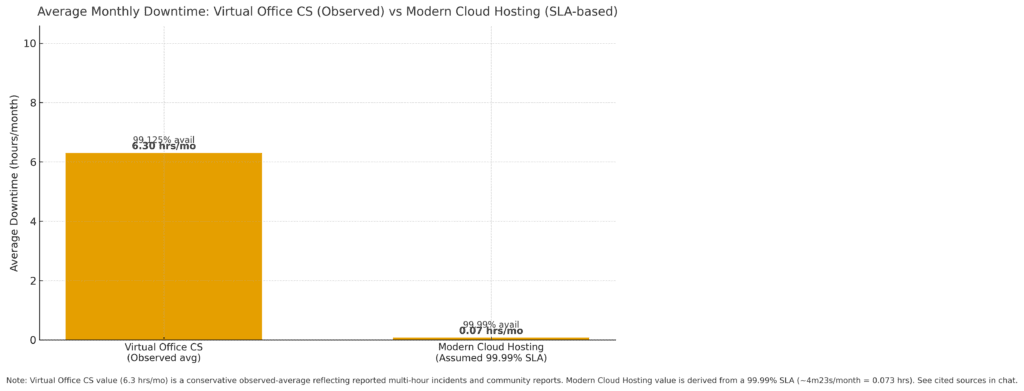
The distinction reflects operational alignment — not marketing positioning.
What Leading Firms Are Doing Differently
Forward-looking firms are adopting infrastructure strategies that prioritize:
- Redundancy planning to prevent single-point failure
- Hybrid hosting safeguards for continuity
- Automation-first workflows to reduce bottlenecks
- Integrated document management for centralized collaboration
- Predictable scaling models before filing surges
- Dedicated accounting-specific support during peak windows
Cloud adoption continues rising as firms prioritize resilience over legacy familiarity.
Frequently Asked Questions
It may remain workable in low-concurrency environments, though growth often reveals limitations.
Many transitions can be completed within weeks when scheduled outside busy season.
Centralized enforcement and automated safeguards typically strengthen compliance posture.
Core applications remain familiar; workflow automation enhancements may require brief orientation.
Conclusion
Tax season is a stress test for infrastructure. Virtual Office CS played a meaningful role in enabling remote access to UltraTax CS and other CS Professional Suite applications. However, as compliance expectations intensify and workflow complexity increases, firms must evaluate whether legacy virtual desktop environments align with modern operational demands.
In 2026, infrastructure is not a background decision. It is a competitive variable. Firms that reassess their hosting environment before busy season arrives gain more than stability — they gain control, resilience, and strategic flexibility in a profession where deadlines are absolute.
Strengthen Your Infrastructure Before the Next Filing Deadline
If your firm is experiencing performance strain, support delays, or scalability limits within Virtual Office CS, the safest time to evaluate alternatives is before peak tax season begins. A structured infrastructure review can reveal hidden risk, improve reliability under concurrency spikes, and ensure your hosting environment aligns with compliance expectations and long-term growth. Modern accounting firms are no longer waiting for outages to force change — they are planning proactively.
- Book a Demo – Experience a scalable, high-availability hosting environment built for UltraTax CS and the CS Professional Suite.
- Request a Quote – Receive a tailored recommendation based on your firm’s size, peak-season load, and security requirements.
- Talk to an Expert – Review your current Virtual Office CS setup and identify practical next steps before busy season arrives.
Also Check Out These Related Articles: