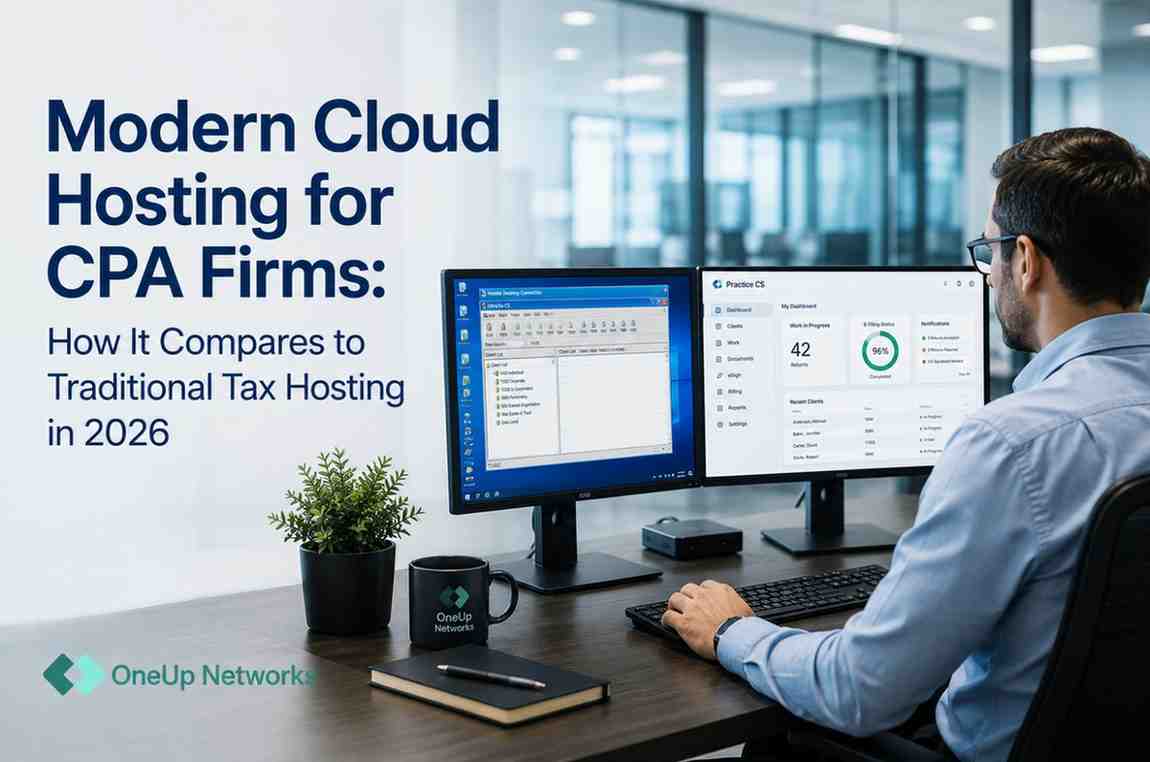
During peak filing season, hosting performance becomes a client-service issue—not an IT inconvenience. When UltraTax CS or the CS Professional Suite slows down, firms lose throughput, deadlines tighten, and staff often resort to workarounds that weaken controls (local installs, unsecured file transfers, unmanaged devices).
In one mid-sized CPA firm, a shared hosting provider hit capacity limits during a filing surge, resulting in multiple days of UltraTax CS disruption. Returns were delayed, internal controls were strained, and leadership was forced into reactive decision-making at the worst possible time.
For 2026, however, those risks are harder to ignore. IRS data protection expectations remain high, and remote work is now standard, while the FTC Safeguards Rule increases the importance of documenting “reasonable safeguards” and vendor oversight. In light of this, this guide outlines what CPA owners and IT decision-makers should require from Thomson Reuters (TR) cloud hosting providers—based on real operational workflows and decision-stage evaluation criteria.
Busy-Season Hosting Requirements CPA Firms Should Treat as Non-Negotiable
- Choose vendors with a current SOC 2 Type II report and safeguards aligned to IRS Publication 4557 expectations for protecting taxpayer data.
- Require documented business continuity targets: RTO and RPO aligned with filing deadlines, not generic “best effort” recovery language.
- Prioritize VDI (Virtual Desktop Infrastructure) to deliver consistent remote access and centralized security enforcement for preparers.
- Verify RBAC, MFA, and audit logging that supports audits, investigations, and vendor oversight.
- Review pricing carefully for peak-season exposure: bandwidth/egress costs, print/PDF subsystem charges, and seasonal scaling premiums.
2026 Hosting Trends: 6 Things Changing This Season
For CPA firms, tax season has always pushed systems to their limits—but 2026 is raising the baseline expectations. Hosting is no longer evaluated like a back-office IT service. It’s now evaluated like operational infrastructure tied directly to revenue, client delivery, and compliance readiness.
Here are six hosting trends shaping busy season decisions this year:
1) Busy-season performance is now a client-service issue
In 2026, firms are no longer asking “Will it stay online?”—they’re asking “Will it stay fast under load?” UltraTax CS and CS Professional Suite workflows create intense concurrency spikes during Q1. That means CS Professional hosting must handle:
- morning login surges
- multi-user return access
- diagnostics and e-file packaging spikes
- high-volume PDF assembly and print queues
Uptime isn’t enough if performance collapses during real filing workloads. Firms are prioritizing vendors who can show busy-season capacity planning and headroom testing, not just SLA language.
2) Security expectations are shifting from controls to proof
Firms are increasingly expected to demonstrate safeguards—not just implement them. In 2026, compliance pressure has made security evidence just as important as security tools. That includes:
- SOC 2 Type II reports (not just “we’re compliant”)
- audit log retention policies
- evidence of MFA enforcement
- vendor oversight documentation
In other words: CPA firms aren’t only buying security—they’re buying defensible security.
3) VDI is becoming the default model for remote access
Remote work is no longer a trend—it’s standard operating procedure. As a result, VDI adoption is accelerating because it provides:
- consistent experience for remote preparers
- centralized enforcement of access controls
- fewer risks from unmanaged home devices
- better containment for taxpayer data workflows
In 2026, more firms are viewing VDI not as a “premium option,” but as the baseline for secure and stable remote tax season operations.
4) Print and PDF systems are emerging as the most common failure point
Most hosting performance issues don’t happen during basic return editing—they happen during packet generation and delivery workflows. Large client packets can overwhelm shared systems and trigger:
- PDF delays
- print queue freezing
- stuck sessions in shared desktops
That’s why leading hosting providers are upgrading print/PDF subsystems or using dedicated services to prevent delivery workflows from becoming a tax-season bottleneck.
5) Disaster recovery is being treated as an operational requirement
After years of ransomware events across professional services, firms are demanding more than “we do backups.” In 2026, hosting evaluation increasingly includes:
- immutable backups
- isolated recovery environments
- documented restore testing
- RTO/RPO aligned with filing deadlines
If disaster recovery isn’t tested, it’s not a DR plan—it’s a hope. Firms are prioritizing providers who can demonstrate recoverability under real-world conditions.
6) Predictable pricing is becoming a deal-breaker
Cloud pricing models are growing more complex, and tax season can amplify costs fast. CPA firms are now closely reviewing contracts for:
- bandwidth and egress charges
- seasonal scaling premiums
- per-user or resource overage fees
- print/PDF subsystem charges
In 2026, decision-makers increasingly want predictable busy-season pricing—not surprise fees that appear only when workloads spike.
CPA Firm Workflows Under Tax Season Pressure
Thomson Reuters environments are not “general-purpose file hosting.” During Q1, CPA firms run concurrent workflows—diagnostics, e-filing, state modules, fixed asset schedules, PDF assembly, and client delivery.
Multi-user tax workflows place heavy load on infrastructure:
- multiple preparers accessing returns simultaneously
- storage IOPS demand during save/scan operations
- CPU and memory spikes during diagnostics and e-file packaging
- print and PDF queues for high-volume client packets
Common operational pain points include:
- slow logins during morning ramp-up
- sluggish PDF generation for delivery packets
- print queue freezes on shared desktops
- inconsistent remote performance due to home bandwidth limitations
CPA-ready hosting is built around seasonal concurrency. Providers that design for steady-state workloads often fail when it matters most.
Key takeaway: If a vendor cannot demonstrate busy-season capacity planning, risk escalates quickly.
Security Controls That Hold Up in Audits (Not Just in Proposals)
In accounting firms, the biggest security problems usually don’t come from advanced attacks. They often happen because basic access controls aren’t set up properly—such as shared admin logins, too many users having high-level access, MFA not being enforced consistently, and activity logs not being monitored or maintained.
At a minimum, hosting should support:
- MFA everywhere (including VDI and administrative access)
- RBAC + least privilege (role-based folder/app restrictions)
- encryption at rest and in transit
- controlled remote sessions with endpoint and malware protection
- disciplined patch governance aligned to UltraTax CS and CS Suite compatibility
Treat audit logs as evidence
Audit logs support:
- incident investigation
- client privacy inquiries
- peer review documentation
- service provider oversight evidence
Many CPA firms set retention policies around 12–18 months, depending on governance and engagement requirements.
Key takeaway: You’re not only buying security—you’re buying defensible security.
What Most CPA Firms Miss When Evaluating Cloud Hosting
Most firms evaluate hosting using generic IT metrics. Busy season exposes the gaps.
Five non-obvious areas to evaluate
- Capacity headroom testing beats SLA language
Ask what happens under 200–300% seasonal demand—not just “uptime guarantees.” - Print/PDF subsystems are common failure points
Bulk delivery packets can collapse shared queues. Dedicated print services often matter. - Legacy compatibility breaks at the worst time
UltraTax add-ons can fail after OS updates. Vendors should show patch discipline and compatibility management. - Bandwidth throttling is often hidden
“Unlimited” plans may degrade during spikes. Require throughput proof. - Subcontracting opacity creates audit friction
If vendors cannot disclose upstream control coverage, audits become harder.
Implementation gotchas to plan for
- RBAC misconfiguration can create admin lockouts mid-season (avoid cutovers without rollback plans).
- Backups fail when restore tests are skipped (restore validation should be routine).
Realistic risk scenario: A ransomware event encrypts Practice CS databases. Without immutable backups and isolated recovery environments, firms face major operational disruption and audit exposure.
Key takeaway: Resilience and recoverability are operational control requirements—especially in regulated client environments.
Vendor Evaluation Process (Decision-Stage)
- Request a current SOC 2 Type II report (and bridge letter if applicable).
- Confirm FTC Safeguards and IRS Pub 4557 alignment and service provider oversight support.
- Validate UltraTax CS and CS Suite patch governance and compatibility management.
- Run a peak-load simulation (logins, e-file workloads, PDF/print volume).
- Review DR evidence: immutable backups and documented restore testing.
- Confirm support model: filing-season escalation coverage and staffing.
- Confirm exit readiness: documented export and transition process.
CPA Firm Cloud Hosting Evaluation Checklist
| Area | Checklist Items |
|---|---|
| Security | MFA enforced everywhere (VDI + admin included), RBAC with least privilege by role, endpoint & malware protection for remote sessions, encryption at rest & in transit |
| Compliance | Current SOC 2 Type II, vendor supports FTC Safeguards service-provider oversight, IRS Pub 4557 safeguards alignment, documented audit log retention |
| Performance | Latency targets validated in real testing, IOPS supports multi-user UltraTax CS activity, capacity planning for seasonal spikes, SLA supports filing deadlines |
| Backup / DR | RTO/RPO aligned to firm tolerance, immutable backups, quarterly restore testing, isolated recovery environment |
| Support | 24/7 coverage during filing season, named escalation paths, patch/change governance |
| Contract & Governance | Transparent pricing, documented exit plan, annual security reporting cadence |
Vendor Red Flags & Deal Breakers
- No SOC 2 Type II (or unwilling to share it)
- Vague “unlimited bandwidth” without peak-throughput evidence
- No immutable backups or restore testing documentation
- No defined UltraTax CS patch governance process
- Offshore-only support with no U.S. escalation
- Audit logs retained for less than 12 months without a governance justification
- Disaster recovery is “planned” but untested
- Busy-season pricing surprises
Case Study: Mid-Sized CPA Firm
- Situation: A 35-user firm in Texas ran UltraTax CS and Practice CS on aging VPS hosting. Remote preparers represented 60% of staff. However, January peaks created 2–5 minute login delays and frequent session instability.
- Complication: Busy season limited migration windows. Additionally, Fixed Assets CS required consistent performance. Moreover, leadership needed stronger safeguards documentation and service provider readiness evidence.
- Decision factors: SOC 2 Type II coverage, recovery design aligned to deadline risk, as well as seasonal capacity planning, VDI performance under load, logging discipline, and change governance.
- Implementation: Migration began in November with parallel testing. RBAC was aligned to workflows. MFA rolled out pre-season. A DR restore test was completed before cutover.
- Results: Login times dropped to ~10 seconds. Remote productivity stabilized. The firm reduced disruption risk and improved audit documentation readiness during filing season.
FAQs
A 99.99% uptime SLA is a strong target. However, it should be backed by peak-season performance proof, clear exclusions, and documented escalation terms.
VDI is recommended because it provides consistent remote access and centralized security enforcement. In addition, it improves stability for multi-user tax workflows during filing season.
At minimum, firms should require MFA, role-based access control (RBAC), encryption, endpoint protection, and audit logging. Moreover, log retention should be documented to support oversight and audits.
Firms should confirm immutable backups, routine restore testing, and RTO/RPO targets aligned with filing deadlines. Otherwise, recovery plans may not meet operational needs during disruptions.
Conclusion
For CPA firms, Thomson Reuters hosting is not a generic cloud purchase. It directly impacts filing-season throughput, client delivery reliability, and safeguards readiness.
In 2026, firms that reduce disruption risk will be those that evaluate hosting against:
- busy-season performance under concurrency
- audit-ready controls and documentation
- proven disaster recovery capability
- predictable pricing and CPA-aware support
Improve UltraTax CS Performance and Busy-Season Uptime with OneUp Networks
If your firm experiences slow UltraTax CS sessions, long morning logins, unstable remote access, print/PDF queue freezes, or hosting downtime during peak filing season, a purpose-built CPA hosting environment can deliver consistent speed, stronger safeguards, and predictable busy-season stability. OneUp Networks helps CPA firms run UltraTax CS, Accounting CS, Fixed Assets CS and the CS Professional Suite on performance-optimized hosted infrastructure with bank-grade security, audit-ready controls, backups, no downtime and disaster recovery designed around filing deadlines.
- Book a Demo – See UltraTax CS running on CPA-ready VDI hosting under real busy-season workflows.
- Start a Free Trial – Test login speed, multi-user performance, and print/PDF processing with no obligation.
- Request a Quote – Receive a tailored hosting plan based on user count, file volume, and busy-season load.
You May Also Like These Articles:
- How to Evaluate Cloud Hosting for Tax and Accounting Software: A Practical Buyer’s Checklist
- Preparing for Audits: How Cloud Hosting Can Help Accounting and Tax Professionals
- Tired of QuickBooks Access Issues? Here’s How to Work Remotely Without the Headaches
- How to Access Thomson Reuters Apps on the Cloud?
- Confused by UltraTax CS? Your Complete Guide with FAQs, Costs, Hosting & Insights