- Learn the core accounting basics for dummies, including assets, liabilities, owner’s equity, debits, credits, journal entries, and the accounting equation.
- Understand key financial statements like the balance sheet, income statement, and cash flow statement to evaluate business performance and financial health.
- Use essential accounting ratios, GAAP principles, and common accounting equations to improve decision-making, compliance, and financial accuracy.
- Discover how cloud accounting and secure cloud hosting from OneUp Networks help small businesses manage records, collaborate in real time, and protect financial data.
Accounting is the key of business—and whether you’re a beginner, a small business owner, or looking to sharpen your financial skills, an Accounting for Dummies cheat sheet is your gateway to clarity. This authoritative guide, and more importantly, will demystify accounting basics for dummies with practical examples, as well as define the most important accounting terms, methods, financial statements cheat sheet, and key ratios. These quick tips, in particular, are useful for everyone looking to succeed in business or finance.
Table of contents
- Why is the Accounting so important in today’s digital world?
- Core Accounting Concepts and Definitions
- Advanced: Key Accounting Ratios (Financial Terms for Dummies)
- GAAP for Dummies: Why Standards Matter
- Cost Accounting for Dummies vs. Managerial Accounting
- Red Flags and Common Accounting Mistakes
- Common Accounting Equations Cheat Sheet
- Practical Example Walkthrough (Accounting for Beginner)
- Quick-Access Accounting Terms Cheat Sheet
- Use Cases: Facts & Figures
- Frequently Asked Questions (FAQ)
- Conclusion
Why is the Accounting so important in today’s digital world?
Accounting is the language of business, because it helps organizations track, understand, and share their financial situation. As a result, over 94% of enterprises report improved decision-making and compliance by leveraging modern accounting methods, especially cloud-based solutions. With this in mind, cloud hosting from OneUp Networks allows accounting and finance professionals to access, manage, and protect their financial data anytime, from anywhere.
Core Accounting Concepts and Definitions
1. The Accounting Equation: The Foundation
Assets = Liabilities + Owner’s Equity
This is the cornerstone of all accounting basics for dummies—every transaction must keep this equation balanced.
| Term | Definition | Example |
|---|---|---|
| Assets | What you own (cash, inventory, equipment) | $5,000 in company cash |
| Liabilities | What you owe (loans, accounts payable) | $2,000 loan from the bank |
| Owner’s Equity | Owner’s residual interest in the company after liabilities are deducted from assets | $3,000 (Asset minus Liability) |
2. Debits and Credits: The Basics
Understanding debits and credits is essential for accounting 101 for dummies.
| Assets Increase | Yes | No | When an asset like cash or equipment goes up, you debit the account. |
| Liabilities Increase | No | Yes | When you owe more (e.g., loans, accounts payable), you credit the account. |
| Owner’s Equity Increase | No | Yes | Owner’s equity grows (from investments or retained earnings), you credit it. |
| Expenses Increase | Yes | No | Expenses reduce equity, so increases are recorded as debits. |
| Revenue (Income) Increase | No | Yes | Revenue increases equity, so it is credited. |
Example: If you buy office supplies for $200 cash, you debit Supplies (+ asset) and credit Cash (- asset) for $200 each—keeping the equation balanced.
3. Understanding the Financial Statements
Accounting is anchored in three primary financial statements cheat sheet that summarize a business’s health:
| Statement | What It Shows | Example in Practice |
|---|---|---|
| Balance Sheet | Assets, Liabilities, Equity at a specific date | Shows $10,000 in assets |
| Income Statement (P&L) | Revenues, Expenses, Net Profit over a period | Profit of $3,500 this quarter |
| Cash Flow Statement | Cash inflows and outflows from operations, investing, financing | Inflows from client payments |
[How to read a balance sheet for dummies: Always keep in mind the formula “Assets = Liabilities + Equity.” This helps you assess what your company owns and owes at a glance.]
4. Accounting Glossary: Key Terms to Know
Whether you download the accounting for dummies pdf or pick up Accounting for Dummies by John A. Tracy, familiarize yourself with these fundamentals:
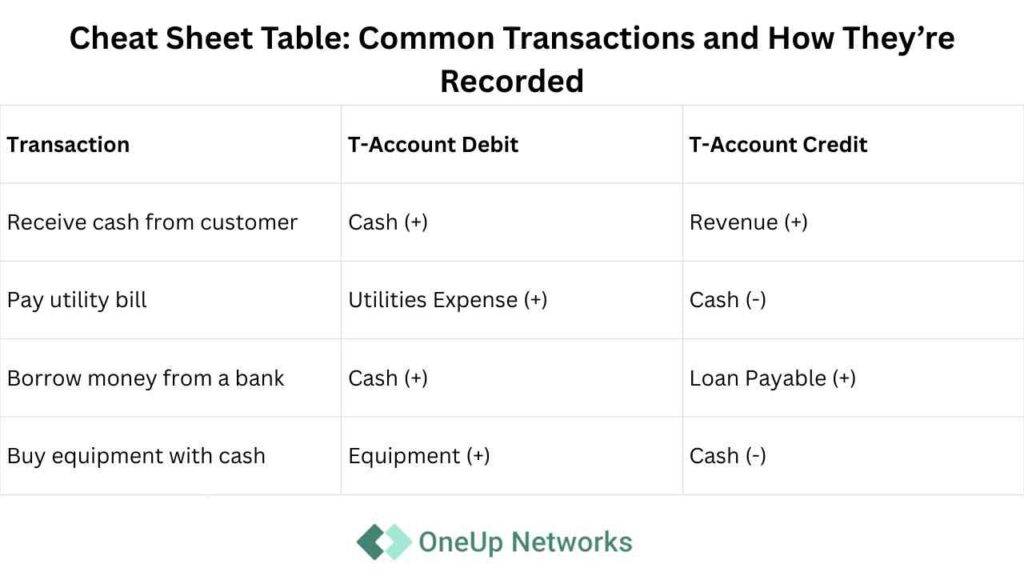
These t-accounts cheat sheet entries ensure every transaction is double-checked for accuracy.
Advanced: Key Accounting Ratios (Financial Terms for Dummies)
Professional accountants rely on ratios for fast financial insights.
Example: A current ratio of 2.0 means you have $2 of assets for every $1 of liabilities—generally considered healthy in the accounting world.
GAAP for Dummies: Why Standards Matter
GAAP (Generally Accepted Accounting Principles) protect the integrity and comparability of accounting records in the US. All public companies, and for the most part, most private ones must adhere to GAAP, which in turn ensures that financial statements cheat sheet are reliable and comparable.
Leading principles include:
- Consistency: Always use the same methods unless a change is disclosed.
- Conservatism: Never overstate assets or income.
- Matching: Match revenues with related expenses in the same period.
- Materiality: Report all significant information.
Cloud Accounting for Small Business
With the rise of small business accounting for dummies, cloud hosting enables you to:
- Automate calculations and tax filing
- Access records from anywhere
- Achieve real-time collaboration with accountants
Cloud-based systems, for the most part, handle over 50% of small business accounting in the USA, due to their scalability and security..
Cost Accounting for Dummies vs. Managerial Accounting
| Feature | Cost Accounting | Managerial Accounting |
|---|---|---|
| Purpose | Track costs of producing goods | Provide info for internal decisions |
| Users | Accountants, managers | Managers, executives |
| Outputs | Product cost reports | Budgets, forecasts, performance reports |
| Example | Cost per widget produced | Department’s quarterly expense budget |
Red Flags and Common Accounting Mistakes
- Misclassifying debits and credits, as shown in the accounting cheat sheet debit credit
- Not applying accrual accounting, which, as a result, is required by GAAP and for most businesses above a certain revenue
- Ignoring reconciliation: Failure to match bank statements with books, in effect, leads to errors
- Not securing financial data: With 80% of ransomware attacks targeting financial data, hosting on secure cloud platforms is, for that reason, crucial for peace of mind
Common Accounting Equations Cheat Sheet
| Equation Name | Formula | Usage |
|---|---|---|
| Accounting Equation | Assets = Liabilities + Equity | Balance check for every transaction |
| Net Income | Revenue – Expenses | Profit calculation |
| Return on Equity | Net Income / Owner’s Equity | Owner’s return on investment |
| Earnings Per Share | Net Income / Shares Outstanding | Evaluates value for shareholders |
Practical Example Walkthrough (Accounting for Beginner)
Scenario: You start a freelance business.
- Deposit $5,000 in bank account (Debit Cash $5,000, Credit Owner’s Equity $5,000)
- Purchase laptop for $1,000 cash (Debit Equipment $1,000, Credit Cash $1,000)
- Send invoice to client for $1,500 (Debit Accounts Receivable $1,500, Credit Revenue $1,500)
- Receive payment for invoice (Debit Cash $1,500, Credit Accounts Receivable $1,500)
With just a few transactions, you have created an income statement, and as a result, balanced your books, and afterward, started your journey in business accounting for dummies..
Quick-Access Accounting Terms Cheat Sheet
| Term | Meaning |
|---|---|
| Debit | Entry on the left; usually asset/expense increase |
| Credit | Entry on the right; usually liability/income increase |
| P&L | Income Statement |
| T-Account | Visual ledger format to illustrate transaction entries |
| GAAP | US Accounting Standards |
| Accrual | Recording transactions when they occur, not just when cash moves |
Use Cases: Facts & Figures
- According to Gartner, the global accounting software market will exceed $19 billion by 2026, and consequently, underscores the need for digital proficiency in today’s market.
- As a matter of fact, 60% of leading accounting firms invest in cloud accounting solutions to enhance client collaboration and security.
Frequently Asked Questions (FAQ)
A: In essence, it’s tracking all the money your business earns and spends—so you know how healthy and profitable your business is.
A: Cash accounting records when money moves; accrual records when events happen, regardless of cash flow.
A: It automates calculations, and additionally, improves collaboration, and boosts security—especially vital for businesses in the USA facing complex tax regulations.
A: For example, many accounting guides and Accounting for Dummies PDFs include a quick-reference sheet to keep by your desk for daily transactions.
Downloadable and Shareable Resources
For a deeper dive, seek out:
- Accounting for Dummies All-in-One by John A. Tracy
- Accounting for Dummies Cheat Sheet
- Financial Accounting Cheat Sheet PDF
- GAAP Quick Reference Guides
Conclusion
In summary, getting a firm grasp on financial management starts with the right foundation—and that begins with an accounting for dummies cheat sheet. From understanding the accounting equation to interpreting financial statements, these financial statements cheat sheet empower you to make smarter business decisions and avoid costly mistakes. Moreover, as businesses continue to move to the cloud, using digital tools becomes essential for both accuracy and efficiency.
As accounting becomes increasingly digital, the demand for professionals who can confidently work with modern financial tools continues to grow. Platforms like Jooble can help professionals find accounting jobs that match their skill set and career direction. At the same time, familiarity with modern accounting solutions enables them to explore these growing career paths and stay updated with digital tools and workflows.
Take control of your business finances with ease—host your accounting software in the cloud with OneUp Networks.
Whether you’re using QuickBooks Hosting, Sage, UltraTax CS, OneUp Networks provides secure, always-on access to your financial data, with top-tier protection, automatic backups, and seamless collaboration from anywhere. No setup fees, no long-term contracts—just reliable, scalable cloud hosting built for accountants and business owners. Get started today with a free Trial.
Don’t Miss These Helpful Blogs: