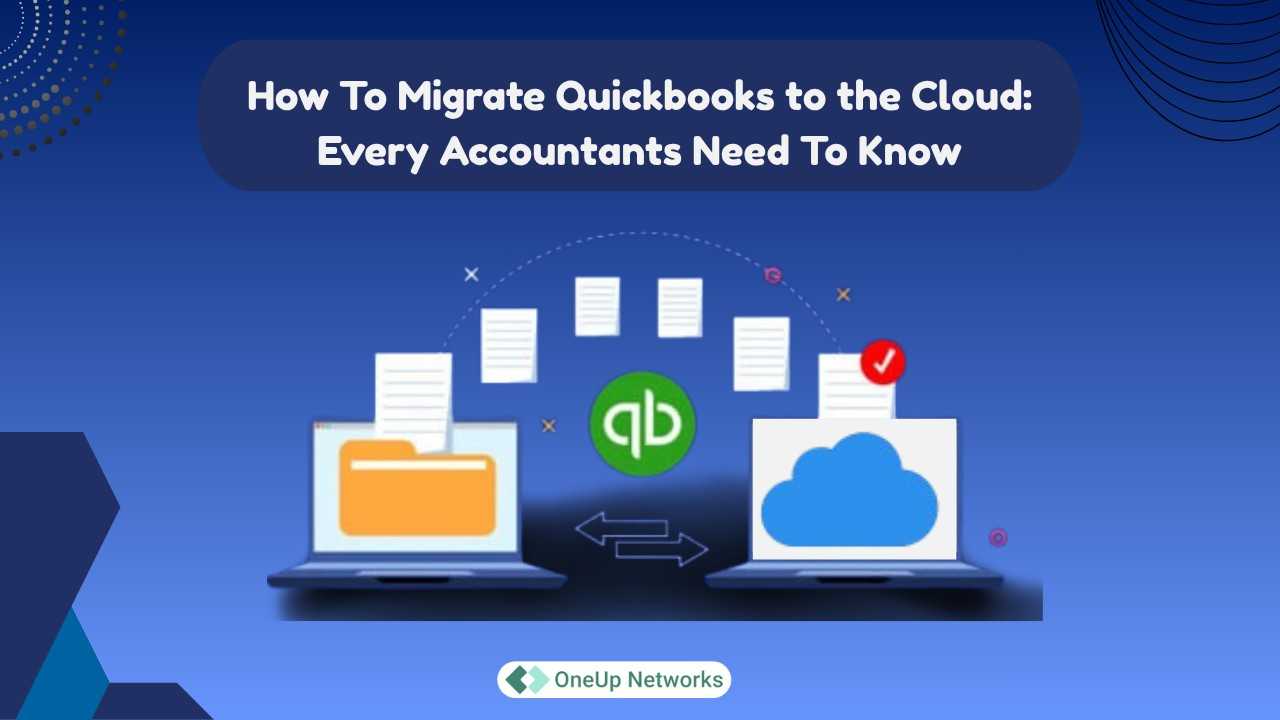
- Migrating QuickBooks to the cloud involves moving your QuickBooks Desktop application, company files, users, and connected workflows from a local environment into a hosted cloud setup.
- A safe migration process includes assessing your current setup, verifying company-file health, creating backups, testing the hosted environment, completing the cutover, and validating accounting data after migration.
- QuickBooks Desktop cloud migration is different from converting QuickBooks Desktop to QuickBooks Online. Hosting keeps your Desktop workflow while moving the infrastructure to a remote environment.
- The biggest migration risks are damaged company files, unsupported integrations, incomplete backups, incorrect user permissions, and moving into a hosted environment without proper testing.
Introduction
Migrating QuickBooks to the cloud involves moving your QuickBooks Desktop application, company files, users and connected accounting workflows from a local computer or office server into a hosted remote environment.
A successful QuickBooks cloud migration requires more than uploading a company file. Before the move, you need to verify the health of your QuickBooks data, create a tested backup, confirm software and add-on compatibility, configure the hosted environment and define a controlled cutover window. After migration, accounting reports, permissions, integrations, payroll functions and everyday workflows must be checked before the new system is accepted as live.
This process is different from converting QuickBooks Desktop to QuickBooks Online. Cloud hosting keeps the QuickBooks Desktop application and interface, while a QuickBooks Online migration moves data into a separate web-based product and may change how some features and historical information work.
This guide provides a practical, step-by-step process for migrating QuickBooks Desktop to cloud hosting. It covers preparation, file verification, backup, pilot testing, secure transfer, final cutover, post-migration validation and rollback planning so your business can move without losing data or creating two competing versions of its books.
Key Takeaways
- Cloud hosting and QuickBooks Online migration are different projects. This guide covers moving QuickBooks Desktop to a hosted server while preserving the Desktop application and workflow.
- Begin with a complete environment inventory. Record QuickBooks versions, company files, users, licenses, payroll services, third-party add-ons, storage needs and peak concurrent usage.
- Check company-file health before transferring anything. Existing corruption, duplicate files or unresolved accounting issues should be identified before the hosted copy becomes the production file.
- Create and test a complete backup. Preserve the company file and any related templates, attachments, payroll forms, integration settings and external files needed by the accounting workflow.
- Run a pilot using real data and realistic user load. Test reports, transaction entry, printing, email, Excel exports, payroll, permissions and every business-critical integration.
- Use a controlled cutover window. Stop data entry in the old environment, create the final backup, restore it in the hosted system and clearly identify which company file is authoritative.
- Validate accounting data after migration. Compare the trial balance, balance sheet, profit and loss, accounts receivable, accounts payable, bank balances, inventory and payroll records across both environments.
- Keep a documented rollback path. Do not retire the source system until accounting and technical owners confirm that data, users and critical workflows operate correctly.
QuickBooks hosting migration versus QuickBooks Online conversion
| Migration path | What changes | Best for |
|---|---|---|
| Desktop to hosted Desktop | The application and file move to a remote server while the Desktop interface remains | Teams needing Desktop workflows with remote access |
| Desktop to QuickBooks Online | Data is converted into a separate browser-based product | Businesses ready to change platforms and workflows |
Do not use a QuickBooks Online conversion tool as though it were the standard method for moving a Desktop company file to a hosted server.
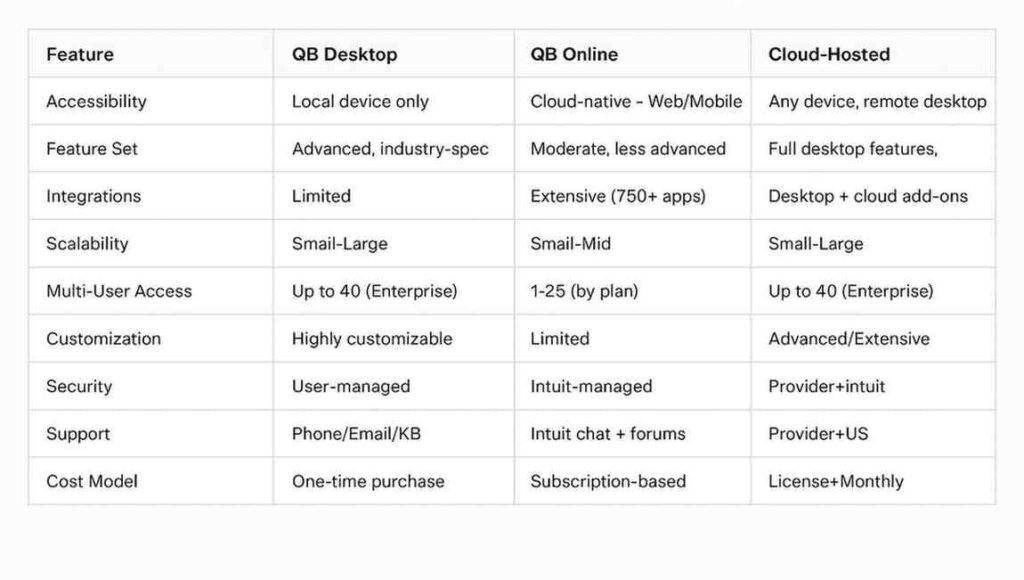
QuickBooks Desktop vs Online vs Cloud Hosting
Below is a comparison chart that summarizes the key differences accountants need to know:
Before migration: define the scope
Create a one-page migration brief containing:
- QuickBooks edition, version, year and license number
- Number of licensed seats
- Company-file names, locations, sizes and owners
- Normal and peak concurrent users
- Payroll, Payments, bank feeds and connected services
- Third-party applications and database connectors
- Microsoft Office, email, printing, scanning and PDF workflows
- User roles and folder permissions
- Backup-retention requirements
- Go-live date and blackout periods
- Acceptable downtime
- Technical owner, accounting approver and escalation contacts
This prevents a common migration surprise: the file opens, but the workflow fails.
Step 1: Confirm the target environment and licensing
Ask the hosting provider to document:
- Supported QuickBooks editions and versions
- Windows and server configuration
- Dedicated versus shared resources
- Storage and backup allocation
- User and Remote Desktop licensing
- Add-on compatibility
- Multifactor authentication
- Access controls
- Support boundaries between the host and Intuit
- File-export and account-termination procedures
Intuit’s authorized hosting program currently supports QuickBooks Desktop Pro, Premier, Accountant Desktop and QuickBooks Enterprise.
Intuit also notes that authorization permits a company to host QuickBooks but does not endorse or guarantee the provider’s service.
Every person should receive an individual login. Shared credentials weaken auditability and complicate access removal.
Step 2: Update, reconcile and clean the source system
Before changing the infrastructure:
- Complete bank and credit-card reconciliations through an agreed date.
- Post or resolve pending transactions.
- Review unapplied credits, negative inventory, duplicate lists and open-item anomalies.
- Confirm payroll and sales-tax filings are current.
- Remove obsolete local copies that could be mistaken for the live file.
- Record the current QuickBooks release and installed add-on versions.
Do not condense data solely to simplify migration without an accountant’s approval. Condensation can affect historical access and reporting.
Step 3: Verify the QuickBooks company file
Close open QuickBooks windows and run:
File → Utilities → Verify Data
Intuit says Verify Data checks the company file for common integrity problems.
If QuickBooks reports that the data has lost integrity:
- Run Rebuild Data.
- Create the backup requested by QuickBooks.
- Allow the rebuild to finish.
- Run Verify Data again.
- Escalate unresolved errors before migration.
Intuit recommends creating a backup before rebuilding and running Verify Data again after the repair.
Record the result. Large or historically troublesome company files should be escalated before the production cutover.
Step 4: Create a complete migration backup
Switch QuickBooks to single-user mode and create a local backup:
File → Back Up Company → Create Local Backup
Select complete verification when available.
Save the backup outside the source computer, use a timestamped filename and keep the pre-migration copy unchanged.
A QuickBooks backup file uses the .QBB extension. Intuit explains that a company-file backup can include accounting data, templates, letters, logos, images and related files.
However, payroll forms are not automatically included. Save the applicable payroll tax-forms folder separately.
Also preserve:
- Custom templates
- Attached-document repositories
- Import and export mappings
- Integration settings
- External credentials or certificates
- Printing and email configurations
Step 5: Build and test before cutover
The provider should install the approved QuickBooks version and required applications in the target environment.
Restore a copy of the company file and conduct a pilot before moving the live file.
Test with representative users and the largest company file:
- Run large reports.
- Enter and save transactions.
- Export reports to Excel and PDF.
- Print and email forms.
- Test payroll, bank feeds and Payments.
- Test every required integration.
- Confirm role-based permissions.
- Measure performance with the expected number of concurrent users.
Practitioner discussions repeatedly mention latency and restrictions around hosted add-ons. These reports are anecdotal rather than universal, but they demonstrate why a real-file pilot is more valuable than an empty demonstration file.
Step 6: Plan the production cutover
Choose a low-activity period and publish a freeze time after which no one may enter data in the old file.
The cutover runbook should include:
- Confirm that all users are out of QuickBooks.
- Switch the source file to single-user mode.
- Run a final Verify Data check if the schedule allows.
- Create the final timestamped backup.
- Record control totals from agreed financial reports.
- Transfer the backup using the provider’s approved secure method.
- Restore or open the file in the hosted environment.
- Configure users, folders, services and applications.
- Complete technical and accounting validation.
- Obtain written go-live approval.
Assign one person to declare which file is live. Two editable “final” files create accounting chaos.
Step 7: Validate the hosted company file
Opening the file is not acceptance.
Compare the same dates, filters and accounting basis in the source and hosted environments.
| Area | Validation check |
| Core accounting | Trial balance, balance sheet and profit and loss |
| Receivables | A/R aging and customer balances |
| Payables | A/P aging and vendor balances |
| Banking | Reconciled balances and outstanding items |
| Inventory | Quantity, valuation, assemblies and locations |
| Payroll | Employee setup, payroll items, forms and connectivity |
| Users | Roles, permissions and concurrent access |
| Operations | Printing, email, PDF, Excel, imports and exports |
| Integrations | Each add-on opens, connects, reads and writes correctly |
| Recovery | The provider can identify and restore the agreed backup point |
Investigate differences before approving go-live.
Do not independently “correct” unexplained discrepancies in both versions of the file.
Step 8: Retain a rollback path
Keep the old environment available but read-only for an agreed acceptance period.
Document:
- Conditions that trigger rollback
- Who authorizes rollback
- Which backup becomes authoritative
- How transactions entered after cutover will be handled
- How users will be redirected to the old environment
Rollback may be appropriate when:
- The company file is incomplete.
- Critical integrations fail.
- Payroll or payment workflows cannot be completed.
- Performance falls materially below the tested standard.
- Permissions are incorrect.
- Financial control totals do not match.
After formal acceptance, archive the source system according to company policy and remove unnecessary access.
Common QuickBooks migration mistakes
- Confusing hosted Desktop with QuickBooks Online conversion
- Migrating without a successful Verify Data result
- Treating the company-file copy as the entire project
- Forgetting payroll forms, templates or attachments
- Failing to preserve integration settings
- Testing with one user when ten will work simultaneously
- Allowing entries in both the old and new files
- Presenting project duration as though it were downtime
- Accepting “daily backup” without restoration details
- Decommissioning the source before accounting approval
- Failing to document how files are returned when the contract ends
Frequently asked questions
Simple files and small user groups may move quickly. Multiple files, large datasets, payroll, custom applications and complex permissions require more preparation. Ask the provider for two estimates:
1. Total project duration
2. Final data-entry freeze window
Do not accept one number that combines both.
.QBW file directly? A provider may use a live company file or a backup depending on its procedure. A verified .QBB backup creates a controlled restore point. Follow the provider’s documented method and retain the untouched source.
Not necessarily. Each application must be licensed, installed and supported in the hosted environment. Test whether it can read and write data correctly, not merely whether the program opens.
Review Intuit’s current support policy first. Intuit discontinued connected services and security updates for QuickBooks Desktop 2023 after May 31, 2026. A hosting provider cannot restore Intuit services that no longer support the installed release.
Match financial control reports and confirm that critical workflows operate correctly. A successful user login does not prove accounting integrity.
Plan Your QuickBooks Cloud Migration Carefully
A successful QuickBooks cloud migration is not simply a matter of copying a company file to another server. It requires a clear inventory of users and applications, a healthy QuickBooks file, a verified backup, a properly configured hosted environment and realistic testing before the final cutover. Treating each of these stages as a controlled checkpoint reduces the risk of missing data, broken integrations, incorrect permissions and operational downtime.
Before approving the hosted system, compare key accounting reports, test payroll and connected applications, confirm every user’s access and preserve a read-only rollback copy of the original environment. Once the financial data and daily workflows have been validated, the hosted file can become the single authoritative version. A documented migration plan gives your team more than a successful transfer; it creates a safer transition with clear ownership, acceptance criteria and recovery options.
Migrate with a Documented Runbook
A successful QuickBooks cloud migration requires more than transferring a company file. It needs a clearly defined scope, verified backup, tested hosting environment, controlled cutover, accounting validation and documented rollback procedure. These checkpoints reduce the risk of corrupted data, broken integrations, incorrect permissions and confusion over which company file is live.
OneUp Networks can assess your QuickBooks version, company files, users, applications and performance requirements before the migration begins. Request a written migration plan covering preparation, pilot testing, secure transfer, user acceptance, financial validation and recovery options so everyone understands what must happen before the hosted environment is approved.
Ready to Migrate QuickBooks to the Cloud?
Book a personalized demo to discuss your migration requirements, start a 15-day free trial to test the hosted environment, or contact OneUp Networks for help with compatibility, pricing and implementation.