Quick Summary
- A managed service provider (MSP) is a third-party technology company that takes ongoing responsibility for agreed IT systems, users and operational tasks.
- MSP services may include infrastructure management, help desk support, cloud operations, system monitoring, patching, security controls, backups and vendor coordination.
- Common MSP models include fully managed IT, co-managed IT, remote support, hybrid service delivery and application-focused managed services.
- An MSP agreement should clearly define covered systems, support hours, responsibilities, response commitments, exclusions, reporting, data ownership and offboarding requirements.
- OneUp Networks provides managed cloud hosting and IT services for businesses and CPA firms that rely on secure remote access, hosted desktops and business-critical applications.
A managed service provider, or MSP, is a third-party technology company that takes ongoing responsibility for defined IT systems, users and operational tasks. Depending on the agreement, an MSP may manage infrastructure, cloud environments, endpoints, user support, security controls, backups and business applications.
Unlike one-time technical support, the managed-service model follows a defined scope, documented responsibilities, continuous monitoring, maintenance and reporting. Some MSPs provide broad IT support, while others specialise in cloud infrastructure, cybersecurity, hosted applications or industry-specific technology environments.
What Does “Managed Service Provider” Mean?
The word managed indicates ongoing operational responsibility. The provider does not simply respond to an isolated technical request; it manages a defined set of systems and tasks according to an agreement.
The word service refers to the recurring activities included in the engagement, such as monitoring servers, handling user tickets, maintaining endpoints or reviewing backups.
The word provider identifies the external company responsible for delivering those services.
An MSP relationship normally includes:
- a defined service scope;
- covered users, systems or devices;
- recurring monitoring and maintenance;
- support channels;
- assigned responsibilities;
- service documentation;
- performance reporting; and
- an agreed pricing structure.
The exact responsibilities differ between providers. One MSP may manage only endpoints and user support, while another may manage cloud hosting, business applications, backups, security controls and vendors as one integrated environment.
What Services Do Managed Service Providers Offer?
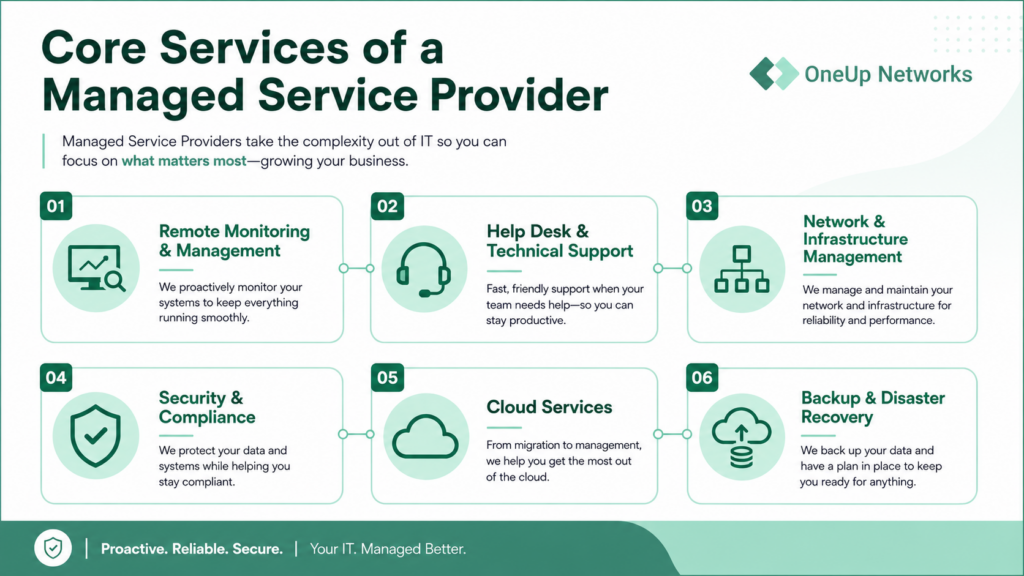
The services offered by a Managed Service Provider can vary depending on the business, its technology, and the level of support required. However, most MSPs provide some combination of the following services.
How Does the Managed-Service Model Work?
The managed-service model converts recurring IT responsibilities into documented workflows.
After the service scope is agreed, the provider normally records the environment, deploys approved management tools and establishes procedures for support, maintenance, monitoring and escalation.
Ongoing service may then include:
- Monitoring covered systems
- Reviewing alerts and scheduled tasks
- Responding to user requests
- Managing approved updates
- Maintaining documentation
- Coordinating third-party vendors
- Reporting service activity and risks
- Reviewing changes in the customer’s requirements
The detailed onboarding, ticketing and escalation lifecycle is covered in our guide to how a managed IT service provider works.
What Services Do MSPs Provide?
Managed service providers offer different combinations of technical services. These can be grouped into six main categories.
1. Infrastructure Management
Infrastructure management covers the systems that support business technology.
An MSP may manage:
- physical and virtual servers;
- networks and firewalls;
- storage;
- internet connectivity;
- wireless systems;
- cloud resources;
- virtual desktops; and
- device performance.
The scope should identify which systems are included and whether the MSP provides remote-only or onsite support.
2. User and Help Desk Support
A help desk gives employees a defined method for requesting technical assistance.
Support may include:
- login and access problems;
- email issues;
- software errors;
- printing problems;
- device troubleshooting;
- new-user setup;
- password resets;
- permission changes; and
- remote-access support.
The agreement should explain support hours, available channels and how requests are prioritised.
3. Monitoring and Maintenance
Monitoring tools collect information from covered systems and create alerts when defined conditions occur.
MSPs may monitor:
- device availability;
- server resources;
- storage capacity;
- backup jobs;
- endpoint-protection status;
- network connections;
- critical services; and
- software or certificate expiry dates.
Maintenance may include patch deployment, system updates, health checks and remediation of failed tasks.
4. Cloud and Hosted Services
A cloud-focused MSP may manage infrastructure, applications, desktops and data hosted outside the customer’s local office.
Services may include:
- cloud-server management;
- virtual desktop infrastructure;
- hosted business applications;
- access management;
- resource monitoring;
- cloud backups;
- performance management; and
- hybrid-cloud connectivity.
Some providers also help coordinate licensed software applications within the hosted environment.
5. Security Operations
Security responsibilities vary considerably between MSPs.
A provider may operate agreed controls such as:
- multifactor authentication;
- endpoint protection;
- firewall management;
- access controls;
- security updates;
- encryption;
- log monitoring;
- vulnerability remediation; and
- privileged-access management.
An MSP can manage defined technical controls, but the customer remains responsible for business policies, risk decisions and applicable legal or regulatory obligations.
6. Backup and Recovery
Backup services protect agreed data and systems according to documented schedules and retention requirements.
An MSP may manage:
- backup jobs;
- offsite storage;
- retention policies;
- failure investigation;
- restoration testing;
- recovery documentation; and
- disaster-recovery procedures.
A completed backup job does not by itself prove recoverability. The service scope should state whether restoration testing is included and how frequently it occurs.
What Types of Managed Service Providers Are Available?
Not every MSP provides the same kind of service.
| MSP type | Primary focus | Typical responsibilities |
|---|---|---|
| General IT MSP | Broad technology operations | Help desk, endpoints, networks, servers and maintenance |
| Cloud MSP | Cloud infrastructure and workloads | Cloud servers, access, performance, backups and resource management |
| Managed hosting provider | Hosted infrastructure and applications | Servers, virtual desktops, application environments and availability |
| Application-focused MSP | Specific software platforms | Hosting, application access, performance and vendor coordination |
| Security-focused provider | Security operations | Monitoring, endpoint controls, access, alerts and incident support |
| Co-managed IT provider | Support for internal IT teams | Additional tools, specialists, monitoring or service-desk capacity |
A provider may operate across more than one category. For example, a managed hosting MSP may combine cloud infrastructure, application hosting, user support, security and backups.
Fully Managed vs Co-Managed IT
The difference between fully managed and co-managed IT is the division of responsibility.
Fully Managed IT
In a fully managed model, the MSP handles most of the day-to-day responsibilities included in the agreement.
This may include:
- user support;
- infrastructure monitoring;
- endpoint management;
- backups;
- patching;
- vendor coordination; and
- operational reporting.
The customer still approves business policies, major changes, access decisions and budgets.
Co-Managed IT
In a co-managed model, the MSP works alongside an existing internal IT team.
For example:
- internal IT may retain strategy and business applications;
- the MSP may provide monitoring and after-hours coverage;
- internal staff may manage users;
- the MSP may operate backups, patching or cloud infrastructure.
The responsibility matrix should identify who owns each activity. Without this clarity, important work can be duplicated or missed.
Businesses deciding between internal, co-managed and fully managed IT can review why companies use a managed service provider.
What Should an MSP Agreement Include?
An MSP agreement should explain what the provider manages, how the service operates and where the provider’s responsibility ends.
Important elements include:
| Agreement area | What should be defined |
|---|---|
| Service scope | Included systems, users, locations and services |
| Service hours | Standard support hours and after-hours availability |
| Support channels | Portal, email, telephone and emergency process |
| Priority levels | How incidents are classified and escalated |
| Response commitments | When the provider will acknowledge or begin work |
| Maintenance | Patching, monitoring and approved maintenance windows |
| Security responsibility | Customer-owned, provider-owned and shared controls |
| Backups | Coverage, retention, monitoring and restoration testing |
| Exclusions | Projects, onsite work, licences or unsupported systems |
| Reporting | Frequency, metrics, open risks and service reviews |
| Data ownership | Ownership of accounts, information and documentation |
| Offboarding | Data return, access removal and transition support |
A service-level agreement should not be interpreted as a guarantee that every issue will be resolved within a fixed period. Some incidents depend on customer approval, external vendors, replacement hardware or software-provider support.
MSP vs MSSP vs Cloud MSP vs Managed Hosting Provider
These provider types overlap, but they are not identical.
| Provider | Main purpose | Typical scope |
|---|---|---|
| MSP | Manage general IT operations | Help desk, endpoints, servers, networks, cloud and backups |
| MSSP | Manage cybersecurity operations | Security monitoring, threat detection, controls and incident support |
| Cloud MSP | Manage cloud platforms | Cloud resources, access, performance, availability and cost controls |
| Managed hosting provider | Operate hosted infrastructure | Servers, virtual desktops, storage and hosted applications |
| Managed hosting MSP | Combine hosting with ongoing IT management | Infrastructure, applications, user support, security and recovery |
The correct classification depends on the services actually delivered, not only the label used by the provider.
A company describing itself as an MSP may provide basic user support, while another may operate a complete hosted application environment. Buyers should review the service scope rather than relying on the provider category alone.
How Do Specialised MSPs Support Accounting Firms?
Some managed service providers specialise in the technical environments used by CPA firms, accounting practices and tax professionals.
These organisations may depend on applications such as:
- QuickBooks Desktop and QuickBooks Enterprise;
- UltraTax CS;
- Thomson Reuters CS Professional Suite;
- CCH applications;
- Sage;
- Drake;
- ATX;
- Microsoft 365; and
- document-management tools.
An application-aware MSP may manage the hosted environment, user access, virtual desktops, backups, infrastructure performance and vendor coordination around these licensed applications.
The MSP does not replace the original software company or provide licences unless specifically authorised to do so. The customer must maintain valid software licensing, while the MSP supports the environment in which the applications operate.
For a detailed industry-focused explanation, read our guide to managed IT services for accounting and CPA firms.
How OneUp Networks Delivers Managed IT and Hosting Services
OneUp Networks provides managed cloud hosting and IT services for businesses and CPA firms that rely on secure remote access, hosted desktops and business-critical applications.
Depending on the selected service scope, OneUp Networks can support:
- managed cloud infrastructure;
- virtual desktops and remote access;
- server monitoring;
- managed backups;
- disaster-recovery planning;
- endpoint and access controls;
- user support;
- application-hosting environments;
- vendor coordination; and
- migration assistance.
The service is structured around the customer’s users, applications, infrastructure and operational requirements rather than a fixed list of generic tools.
Explore OneUp Networks’ managed service provider solutions for service details, supported environments and consultation options.
Frequently Asked Questions
MSP stands for managed service provider. It refers to a company that manages defined technology systems and operational responsibilities for another organisation on an ongoing basis.
An MSP may manage endpoints, servers, networks, cloud resources, user support, security controls, backups, hosted applications and vendors. The exact responsibilities depend on the agreement.
Not always. Traditional IT support may focus on individual problems or projects. An MSP assumes recurring responsibility for an agreed service scope and normally includes monitoring, maintenance, support and reporting.
No. An MSP normally manages broader IT operations, while an MSSP focuses primarily on cybersecurity. Some providers offer both managed IT and managed security services.
The customer should retain ownership of its data, domains, cloud tenants, accounts and core business information. Ownership, access and offboarding requirements should be stated in the agreement.
A managed hosting provider operates hosted servers, infrastructure, virtual desktops or application environments. Some managed hosting providers also deliver help desk, security, backup and broader IT services.
Final Takeaway
A managed service provider is an external technology partner that assumes ongoing responsibility for defined IT systems and operational tasks. The MSP model may include infrastructure management, help desk support, cloud operations, security controls, backups, hosted applications and vendor coordination. However, the exact service depends on the provider type, delivery model and agreement.
The most important distinction is not whether a company calls itself an MSP. It is whether the provider clearly defines what it will manage, how it will deliver the service, what the customer must retain and how performance will be documented.
Need a Managed Service Provider That Understands CPA Firms?
Whether you’re struggling with slow applications, unreliable backups, security concerns, or outdated IT infrastructure, the right MSP can make a significant difference. OneUp Networks specializes in managed cloud hosting and IT services for CPA firms and businesses, helping you improve performance, strengthen security, and keep your critical accounting applications running smoothly.
- Start a FREE Trial and experience secure managed cloud hosting.
- Book a Free Demo to see how our managed hosting environment works.
- Speak to an MSP Expert for personalized guidance based on your business needs.
- Request a Custom Quote tailored to your users, applications, and infrastructure.