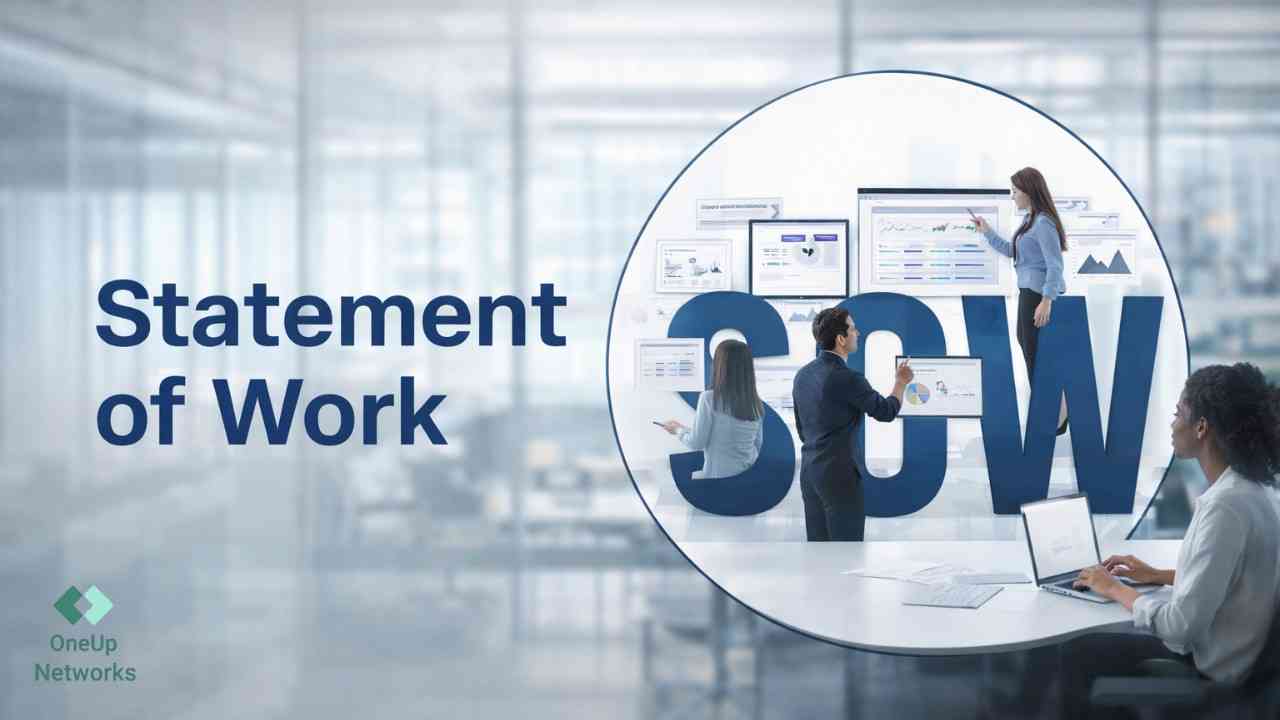
Most project issues begin with unclear scope. This is where understanding what is a Statement of Work (SOW) becomes essential. A consulting firm once agreed to provide “ongoing advisory support.” Within a few months, the client expected weekly strategy sessions, while the firm had planned for occasional guidance. The disagreement didn’t come from poor work. It came from undefined expectations.There was no clear Statement of Work. That gap—between what teams assumed and what they defined—is exactly what a SOW eliminates. This is especially relevant in service-based and cloud-driven business environments.
What Is a Statement of Work (SOW)?
A Statement of Work (SOW) in managed services is a formal document that defines the scope, deliverables, timeline, responsibilities, and terms of a project between a client and a service provider. In simple terms, it translates a general agreement into something measurable and enforceable. A well-structured SOW answers five essential questions:
- What work will be done
- When it will be completed
- How it will be delivered
- Who is responsible
- How success will be measured
Without a SOW, projects rely on interpretation. With one, a SOW aligns expectations before work begins.
SOW Meaning in Business (Definition and Practical Context)
In a business context, the SOW meaning refers to the operational blueprint of a service engagement.
SOW stands for Statement of Work, and teams use it widely across:
- consulting
- IT services
- accounting
- project management environments
When someone asks “what does SOW mean?”, they refer to the document that defines how teams will actually carry out work—not just what they agreed in principle. It is important to distinguish this from informal agreements. A SOW is not a summary. It is a working document.
Why Is a Statement of Work Important in Project Management?
Most projects do not fail because teams lack capability. They fail because expectations never fully align.A SOW reduces this risk by making expectations explicit before execution begins. It:
- defines boundaries
- clarifies deliverables
- creates a shared reference point
In practice, a SOW does not eliminate issues—but it makes them easier to resolve. Without it, disagreements become subjective. With it, teams can measure them.
What Should a Statement of Work Include? (Structure Explained)
A strong SOW is not about length—it is about precision. It typically includes:
- A clearly defined project scope
- Specific deliverables that teams can verify
- Timelines and milestones
- Roles and responsibilities
- Pricing and payment terms
- Acceptance criteria
- A process for handling changes
However, structure alone is not enough. The quality of a SOW depends on how clearly teams define each element. A complete document with vague language is more dangerous than an incomplete one—it creates false confidence.
Good vs Bad Statement of Work (Why Clarity Matters)
The difference between a weak and strong SOW is rarely structural. It is almost always in the wording.
A weak SOW might state:
“Provide advisory support as needed.”
A strong SOW defines:
“Provide up to 10 hours per month of financial advisory services, delivered through scheduled calls or written analysis, with additional hours billed separately.” Both describe the same service. Only one removes ambiguity.
Statement of Work Example
Consider an accounting firm onboarding a business client. Without a SOW, the agreement might include “tax preparation and advisory services.” Over time, this could expand into additional filings, extended consultations, and unplanned work.
With a SOW:
- Specific returns are listed
- Advisory hours are defined
- Deadlines are documented
- Additional work is defined separately
The difference is not in the service—it is in how clearly teams define it.
Statement of Work Template
A typical statement of work template includes:
- Project overview
- Scope of work
- Deliverables
- Timeline and milestones
- Roles and responsibilities
- Pricing and payment terms
- Acceptance criteria
- Change management process
- Terms and conditions
Templates provide consistency, but clarity comes from how teams write each section.
Types of Statement of Work (SOW)
Different engagements require different levels of control.
- Design SOW — defines how teams must perform the work
- Level of Effort SOW — focuses on time and resources
- Performance-Based SOW — defines outcomes, leaving execution flexible
Each type reflects a different balance between structure and adaptability.
SOW vs Contract: What’s the Difference?
A contract defines the legal relationship between parties. A SOW defines how teams will actually perform the work within that relationship. In most cases, teams attach the SOW to the contract and use it as its operational layer.
When a Statement of Work Fails (Even When It’s Well Written)
A well-structured SOW reduces ambiguity, but it does not eliminate it entirely. In practice, issues can still arise even when teams define scope, deliverables, and timelines clearly.
Consider a scenario where a SOW specifies: “Provide monthly financial reports with performance insights.”
- The deliverable is clear. The timeline is defined. Yet interpretation can still differ.
- The client may expect strategic recommendations and forward-looking analysis.
The service provider may deliver structured reports with limited commentary. - Both parties follow the SOW. The disagreement comes from how each interprets “insights.”
- This is where experienced teams go beyond documentation.
They:
- clarify expectations through examples, not just descriptions
- define the depth and format of outputs
- align early through sample deliverables or trial phases
A SOW creates clarity—but teams must reinforce that clarity through communication. The goal is not just to define work, but to ensure both sides interpret that definition in the same way.
Practical Rules for Writing a Strong SOW
In practice, effective SOWs follow a few simple but often overlooked principles:
- If a deliverable cannot be verified, it is not clearly defined
- If scope is open-ended, pricing must include boundaries
- If responsibility is shared, ownership must still be assigned
- If timelines are flexible, teams must explicitly state expectations
These are not formatting rules—they are decision rules that determine whether a SOW actually works.
When Should You Use a Statement of Work?
A SOW becomes essential when:
- work involves multiple deliverables
- timelines must be enforced
- billing depends on defined scope
- multiple stakeholders are involved
For simple tasks, it may be unnecessary. For structured engagements, it becomes a core control mechanism.
How Statement of Work (SOW) Applies to Cloud Hosting and CPA Firms
In modern business environments, SOWs are widely used in cloud hosting, managed services, and accounting workflows.
For CPA firms and organizations working with cloud-based systems, a SOW typically defines:
- scope of hosting services and system access
- responsibilities for data security and compliance
- service-level expectations such as uptime and support
- boundaries between standard services and additional work
In cloud environments, unclear definitions can lead to misunderstandings around system performance, security responsibilities, or support scope.
Because many of these situations are interpreted based on agreements, a well-defined SOW helps ensure that both service providers and clients operate with clear expectations—especially in regulated and compliance-driven industries.
Frequently Asked Questions (FAQs)
A SOW is a document that defines how a project or service engagement will be delivered.
Scope of work defines tasks. A SOW includes scope, deliverables, timeline, and terms.
It can be legally binding when included within a signed agreement.
An example includes clearly defined services, timelines, deliverables, and pricing for a client engagement.
Final Perspective
A Statement of Work is not just documentation—it is alignment. It ensures teams define expectations before execution begins, reduces ambiguity, and prevents avoidable conflict. In professional environments where time, accuracy, and accountability matter, that clarity becomes essential.
Projects rarely fail because people lack capability. They fail because teams never make expectations explicit. A well-written SOW closes that gap before it becomes a problem.
Improve Project Execution with OneUp Networks
For accounting and professional service firms, clarity in scope is only part of delivery. System reliability, secure access, and infrastructure performance directly affect how teams execute work—especially during peak periods.
OneUp Networks helps firms build stable, secure environments aligned with real operational workflows.
- consistent performance during high-demand periods
- secure remote access across teams
- infrastructure designed for accounting and tax applications
Book a Demo – Review your current setup
Request a Quote – Get tailored recommendations
Talk to an Expert – Discuss your requirements
You May Also Like These Articles:
- How Can P&L Analysis Unlock Sustainable Business Growth?
- QuickBooks Pro & Premier Saying Goodbye?
- Backup & Disaster Recovery for CPA Firms: Protecting Tax and Accounting Operations
- Accounting for Dummies Cheat Sheet: Essential Guide for Beginners & Professionals
- Understanding IAM, PIM, and PAM: What Is The Difference?