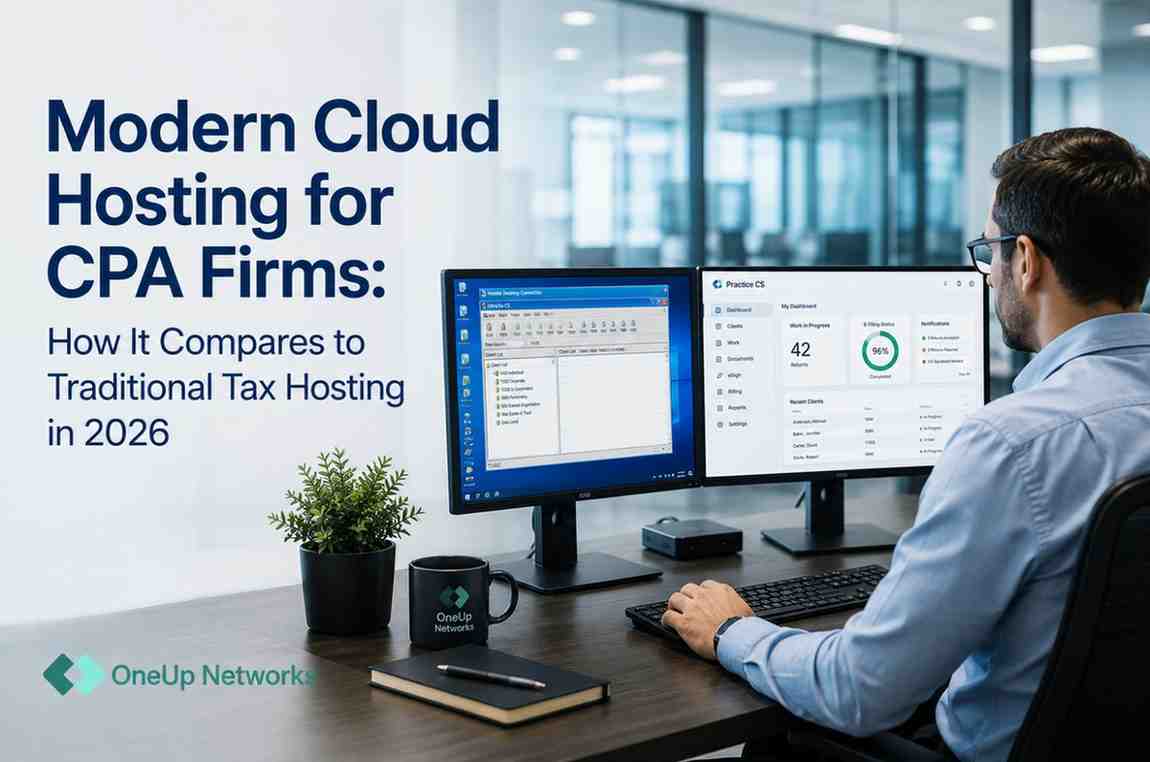
If UltraTax slows down every March, staff lose billable hours waiting on spinning screens, and remote access feels unreliable, your firm has likely outgrown traditional server infrastructure. For many practices, this is the point where UltraTax CS cloud integration becomes a serious consideration — not as a technology upgrade, but as an operational necessity.
UltraTax CS cloud hosting allows CPA firms to run UltraTax CS on dedicated, professionally managed infrastructure designed for multi-user tax workloads. Instead of relying on aging office servers and VPN connections, firms can host UltraTax CS in the cloud with predictable performance, secure remote access, and structured disaster recovery. This guide explains how UltraTax CS cloud integration works, what changes operationally, and how UltraTax hosting for CPA firms supports busy-season stability without altering daily tax preparation workflows.
Executive Summary for Managing Partners
Hosting CS Professional Suite’s UltraTax replaces aging on-premise servers with dedicated infrastructure engineered for tax-season concurrency.
Firms gain:
- Predictable performance during peak filing weeks
- Secure remote access without VPN instability
- Built-in backup and disaster recovery systems
- Scalable infrastructure aligned with growth
For many CPA firms, cloud integration is no longer an IT upgrade. It is a business continuity strategy.
UltraTax Cloud Readiness: Where Most Firms Begin
Before making any change, firms typically evaluate whether their current environment is still adequate.
A readiness review examines:
- Whether the server is properly sized for real concurrent users
- Whether remote staff rely on unstable VPN access
- Whether storage performance is sufficient for growing databases
- Whether peripheral devices (printers, scanners, monitors) will transition smoothly
- Whether migration can be scheduled outside peak filing windows
This step ensures that UltraTax CS cloud integration is implemented strategically—not reactively.
UltraTax CS Cloud Sizing: Minimum vs Recommended Infrastructure
When evaluating UltraTax CS cloud integration, infrastructure sizing should reflect real concurrency, return complexity, and database growth — not just user count. The following configurations represent common starting points for firms planning to host UltraTax CS in the cloud. Final sizing should always be validated against peak tax-season workload behavior.
Small Firms (1–5 Users)
- 4 vCPUs
- 16–32 GB RAM
- 250–500 GB SSD (high IOPS)
Mid-Size Firms (6–15 Users)
- 8–12 vCPUs
- 32–64 GB RAM
- 500 GB–1 TB SSD (high IOPS)
Growing Firms (15+ Users or High Return Volume)
- 12–16+ vCPUs
- 64–128+ GB RAM
- 1 TB+ NVMe storage (enterprise-grade IOPS)
These are not rigid templates. A professional provider of UltraTax hosting like OneUp Networks sizes environments based on:
- Concurrent preparer activity
- Calculation intensity
- File size and document storage growth
- Remote access patterns
- Filing deadline workload spikes
Proper sizing prevents under-provisioning of UT cloud during peak season and ensures that UltraTax cloud hosting delivers consistent performance when demand is highest.
When UltraTax Cloud Hosting Makes Operational Sense
UltraTax cloud hosting typically becomes a logical move when:
- Tax-season performance becomes unpredictable
- Remote or hybrid staffing is permanent
- Server replacement cycles are approaching
- IT maintenance disrupts productivity
- Business continuity becomes a leadership concern
On-premise infrastructure may still be acceptable when all staff work on-site, hardware is new and properly sized, and remote access is minimal. However, even in those environments, firms often plan eventual migration to reduce long-term risk.
How UltraTax CS Runs in the Cloud
UltraTax CS operates within Windows-based environments. With cloud integration, the application runs on a dedicated virtual server inside a professionally managed data center rather than on physical office hardware.
From a user perspective, nothing changes. Staff connect through secure remote desktop, open UltraTax exactly as before, and continue preparing returns normally.
The difference lies behind the scenes:
- Processing occurs on dedicated cloud infrastructure
- Data remains centralized and encrypted
- Backups and recovery systems operate automatically
- Performance resources are reserved for your firm
UltraTax hosting for CPA firms focuses on infrastructure stability, not software modification.
UltraTax CS Cloud Integration vs. UltraTax CS Hosting
UT cloud integration means moving the infrastructure that supports UltraTax CS from local office hardware to a managed cloud environment. The software experience stays familiar for users, but the server, access, backups, security controls, and disaster recovery are managed in a hosted environment.
UltraTax CS hosting is the service model that makes this possible. OneUp Networks hosts your existing UltraTax CS license on secure, dedicated infrastructure so your firm can access UltraTax CS remotely, support multiple users, and reduce the burden of maintaining local servers.
On-Premise Servers vs UltraTax Cloud Hosting
| Area | On-Premise Server | Dedicated Cloud Hosting |
|---|---|---|
| Performance | Limited by hardware capacity | Scalable CPU and RAM |
| Storage | Often constrained | High-IOPS SSD / NVMe |
| Remote Access | VPN dependency | Secure direct login |
| Maintenance | Internal IT responsibility | Fully managed |
| Tax Season | Bottlenecks common | Engineered for peak concurrency |
| Recovery | Manual processes | Automated backup & disaster recovery |
The core distinction is flexibility. On-premise servers have fixed ceilings. Cloud infrastructure adjusts to workload realities.
Multi-User UltraTax CS Architecture and Concurrent Access
UltraTax CS supports multi-user operation by design. Performance issues typically stem from infrastructure limits—not from the application itself.
When firms host UltraTax CS in the cloud, they gain:
- Dedicated CPU allocation for calculations
- Scalable memory for multiple open returns
- High-speed storage optimized for database activity
- Stable concurrent access across locations
This ensures one preparer’s workload does not degrade performance for the entire team.
UltraTax Performance During Peak Filing Season
Tax season introduces workload spikes that expose server weaknesses:
- CPU usage increases during heavy calculations
- RAM is consumed by multiple open returns
- Disk I/O intensifies as databases expand
- VPN connections strain under remote demand
UltraTax cloud hosting addresses these pressures with reserved virtual CPUs, expandable memory profiles, and high-performance SSD or NVMe storage designed for accounting workloads. Rather than oversizing hardware “just in case,” firms deploy right-sized cloud infrastructure that aligns with real usage patterns.
UltraTax Cloud Security and IRS Compliance Considerations
Professional UltraTax hosting for CPA firms typically includes:
- Encryption at rest and in transit
- Multi-factor authentication
- Role-based access controls
- Audit logging
- Daily automated backups
- Disaster recovery systems
However, infrastructure security and governance are not the same. Hosting providers manage the environment, while CPA firms retain responsibility for user permissions, access reviews, safeguarding policies, and compliance documentation under IRS and FTC requirements. Effective cloud integration supports governance—but does not replace it.
Recovery Objectives and Business Continuity
Modern firms increasingly define infrastructure success through measurable targets:
- Recovery Time Objective (RTO): 3–4 hours
- Recovery Point Objective (RPO): 2–4 hours
UltraTax CS cloud migration supports these goals by enabling isolated recovery environments and structured restoration processes. During an outage, staff can reconnect remotely while IT investigates root causes—reducing revenue disruption during filing deadlines.
Peripheral Compatibility: Printing, Scanning, and Multi-Monitor Support
Cloud integration does not eliminate office workflows. Modern hosted environments support:
- Dual and multi-monitor configurations
- Local printer redirection
- Centralized print servers
- Scan-to-network folders integrated with document systems
Devices are typically validated before production cutover to ensure day-one continuity.
UltraTax CS Cloud Migration Process
A properly planned UltraTax CS cloud migration follows a staged approach:
- Environment assessment
- Cloud server provisioning
- Data synchronization and validation
- Final cutover with rollback protection
For many small-to-mid CPA firms, the transition completes within 24–48 hours, scheduled outside business hours to minimize disruption.
Signs Your UltraTax Infrastructure May Be Limiting Growth
Firms often evaluate cloud hosting when:
- Staff regularly wait on system responsiveness
- Remote access becomes unstable
- Servers approach replacement age
- IT troubleshooting disrupts client work
- Filing deadlines feel increasingly stressful
These signals typically indicate infrastructure strain—not software deficiency.
UltraTax CS Cloud Hosting FAQs
Most small-to-mid firms complete cutover within 6-7 hours using staged synchronization.
No. UltraTax CS operates exactly the same. Only the server location changes.
Yes. Cloud servers are engineered for concurrent access.
Yes. Hosted environments support dual monitors, printing, and scanning workflows. You can refer the Ultratax guide to get started
Hosting environments support IRS safeguarding standards, but firms retain responsibility for governance and internal policy enforcement.
Yes. Depending on the firm’s workflow, UltraTax CS can be hosted alongside other tax, accounting, Microsoft, QuickBooks, and CS Professional Suite applications in a managed cloud environment.
UltraTax CS cloud integration is the process of moving the application environment to the cloud. UltraTax CS hosting is the managed service that runs your licensed UltraTax CS software on secure cloud infrastructure.
Final Perspective: Building Reliable UltraTax Infrastructure
UltraTax CS cloud integration is not about adopting new software—it is about ensuring the infrastructure supporting your tax workflows can sustain busy-season demand, remote access requirements, and long-term growth.
When implemented thoughtfully, Thomson Reuters UltraTax cloud hosting provides consistent performance, structured recovery readiness, and operational predictability without disrupting daily workflows. For managing partners, the value is not technical—it is strategic. Infrastructure decisions made today shape how confidently your firm operates during filing deadlines tomorrow.
UltraTax CS Cloud Hosting with OneUp Networks: A Modern Alternative to Virtual Office CS
If your firm is evaluating UltraTax CS cloud integration, planning to host UltraTax CS in the cloud, or assessing whether your current servers can handle another busy season, now is the time to review your infrastructure. Hosted Ultratax is not just about remote access—it’s about predictable performance, structured disaster recovery, and reducing the operational risk that surfaces when deadlines matter most.
For larger CPA firms or multi-application practices, OneUp Networks’ Total Practice Plan can support UltraTax CS, CS Professional Suite applications, QuickBooks, Microsoft apps, add-ons, backups, disaster recovery, and premium support in one managed hosting environment. It is designed for firms that need more than basic tax software hosting during busy season.
- Book a Demo – See UltraTax CS running in a purpose-built cloud environment designed for multi-user CPA workloads.
- Start a Free Trial – Test login speed, calculation performance, and remote access stability before committing.
- Request a Quote – Receive a tailored UltraTax hosting plan based on user count, file volume, and peak-season concurrency requirements.
Don’t Miss These Must-Read Articles:
- Why Should Your Business Choose UltraTax CS Hosting?
- Confused by UltraTax CS? Your Complete Guide with FAQs, Costs, Hosting & Insights
- UltraTax CS Cloud Hosting, Thomson Reuters Hosting
- How to Move UltraTax CS to the Cloud: A Step-by-Step Guide for Accounting & Finance Firms
- UltraTax Virtual Office CS Downtime Fixes: Key Strategies for Tax Professionals